
books 2026
📚 Books 2026, 22: All That We See or Seem, by Ken Liu
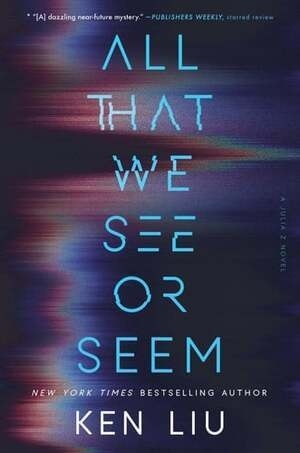
Ken Liu is best known (to me at least) as the translator of the first and third volumes of Liu Cixin’s ‘Three-Body Trilogy’. But he’s an accomplished SF author in his own right.
All That We See or Seem (described as the first of a series, because of course) is a cyberpunk story, in the sense that it’s set in the near future and concerns hacking. The lead character, who goes by ‘Julia Z’, was a member of hacking group as a teenager, and after it got broken up and the leaders arrested, she is trying to live on the right side of the law.
But that’s all backstory, with details revealed to us gradually as the main story needs them. In the book’s present, she is approached by a man whose wife has gone missing and is seemingly being held to ransom by a criminal gang. Piers wants Julia to use her skills to find his wife, Elli. Elli is an ‘onierofex’, or dreamweaver: a talent in a new form of entertainment where people enter shared dreams. The mechanism for this is not entirely clear, but it involves scanning the participants brains in some form.
There are gangsters after them, of course, and we’re off. One thing that struck me about this is, you recall the ‘capable man’ stories of the so-called Golden Age of SF? The heroes of Heinlein, John W Campbell, or Doc Smith stories, who could turn their hand to just about anything the plot required?
Well Julia is very much a ‘capable young woman’, in what feels like a surprisingly similar vein. As a hacker, she can do smart things with computers, of course. But she also turns her hand to smart-drone design; counter-surveillance (OK, that’s kind of computer/hacker-related); and ultimately intrusion, in the form of breaking into an enemy base.
It’s all convincingly done, don’t get me wrong. While you’re reading it, you’ll mostly believe it’s all plausible, she’s convincingly drawn. But looking back, wow: that’s quite some capability.
It’s good, though. I recommend it.
📚 Books 2026, 21: Hum, by Helen Phillips

A story set in a dystopian near-future, where everything is much the same as today but just that bit worse. And there are humanoid robots everywhere (in the US city in which it’s set, at least). For reasons that are never explained they are called ‘Hums’. I’m guessing it’s because ‘hum’ is nearly ‘human’.
They operate autonomously and are helpful, but it’s not clear who owns or controls them. They advertise products both in conversation and by displaying things on screens on their chests.
The main character, May, has lost her job to AI, and the family is struggling to get by on her husband’s gig-work. May volunteers for experimental facial surgery which make changes that are minor, but noticeable by people, and crucially, which prevent facial recognition systems from picking her up. Which causes problems, as well as providing a windfall which she uses to take the family to the ‘Botanical Gardens’, which are a recreation of unspoilt countryside in the middle of the city.
Problems ensue, and stuff happens. Mostly interpersonal conflict between May and her kids. The message it’s sending is ambiguous. The hums seem to be antagonistic, or at least annoying for much of it, but one of them might be their saviour by the end.
The cover boasts ‘Winner of the Climate Fiction prize’, which is odd, because while the climate and damage to it is there as background — not least in the fact that the only way they can experience nature is to go to an artificial zone — it’s not really about that. It’s more about the surveillance state and the ubiquity of advertising, as well as the difficulty of life under late-stage capitalism.
Which are all interlinked, of course. It makes this kind of a depressing read, though the characters are engaging enough.

📚 Books 2026, 19: Persuasion, by Jane Austen
I’m perhaps reading with too much of a modern writer’s eye these days, because I was constantly thinking, while reading this Penguin Popular Classics edition of Persuasion: it’s all telling, no showing at all!
Which is not entirely true, and I’ve also commented in the past on these pages, that we shouldn’t treat that instruction as sacrosanct anyway. There are plenty of times where telling is the best way, the right way, to approach part of a story. We call it storytelling after all. And this is Jane Fucking Austen!
So yes, there is a sense at times that we’re skating across the surface of things, not really seeing the interiority of Anne, except when we are; and there are times when the narration switches from close-third-person to omniscient, in a way that can be slightly confusing: are we getting Captain Wentworth’s thoughts here, or is it Anne projecting what she thinks he’ll be thinking?
But I still sat up till 2 o’clock finishing it.
The oddest thing is the way how some dialogue is rendered. There’s a lot of free indirect speech, including in places where I would have preferred actual, reported speech (and as I write I realise that’s probably the main cause of the slight disconnect I felt). But there are some parts where direct and indirect speech seem to be merged in the oddest way.
Here’s an example from chapter VI:
Mary deplored the necessity for herself. ‘Nobody knew how much she should suffer. She should put it off as long as she could;’
The section in quotes is clearly meant to be Mary’s dialogue, but the ‘she’ in question is Mary herself. There are numerous examples like this throughout the book, but it’s far from all instances of reported speech. Just at the end of the paragraph immediately before the above, we have :
Mary, who, on having occasion to note down the day of the month, exclaimed, ‘Dear me, is not this the day the Crofts were to come to Kellynch? I am glad I did not think of it before. How low it makes me!’
Similar formulation, but conventionally structured. Now there’s no absolute ‘correct’ way to render speech. Everything we use today is a convention. But I don’t recall that kind of formulation in Austen before. I would say I don’t recall seeing it anywhere before, except I think there was a similar instance in my recent reading of Moby Dick. But a singular instance in a long book like that feels like a genuine mistake, whereas here it was surprisingly frequent.
My minor gripes aside, it deserves its place in the literary hall of fame.
📚 Books 2026, 18: Moby Dick, by Herman Melville

Took me a few months to get through this, and with a couple of interruptions — actually three. Why the interruptions, given I really enjoyed it? It’s a dense work, if not fantastically long at some 530 old-school paperback pages in the Penguin Popular Classics edition I have. Sometimes I felt like reading something a bit easier.
Which suggests it’s hard work, for which it does have a bit of a reputation. But actually it’s mostly not. But that ‘mostly’ goes to the heart of what’s so fascinating about it.
Mention Moby Dick to most people and they’ll think of the eponymous white whale and the infamous monomaniac Captain Ahab. Which is fair enough. But most of the book is not actually about Ahab and his obsession or quest at all. There is one early scene where he insists the whole crew take an oath to hunt the titular whale as their highest priority — it chomped off his leg, and he’s out for revenge, after all. But before that, and for much of what follows, Ahab hardly features in the story.
It’s the last fifth or so, maybe quarter, where he comes to the fore and we get the real hunt for Moby Dick.
Most of the rest — by far the bulk of the novel — consists of Melville’s, or the narrator ‘Ishmael’s’ — disquisitions on life, humanity, philosophy, religion, the sea, sailing, and of course, whales. ‘Call me Ishmael’, though, that famous opening line:1 it tells us we’re getting a first-person narrative. Which is true in part.
But it isn’t long before Ishmael — or Melville — sets that aside and tells us what’s going on in another character’s head. And then we’re off to the modernist, if not postmodernist, races, because this book cheerfully switches between first and third, turns into a play script or a dictionary, and generally uses any writerly techniques of Melville’s/Ishmael’s choosing to say what needs to be said.
It sounds, and could be in hands of a lesser writer, chaotic. If a first-time author today submitted such a manuscript to an editor — or to a friendly writers' group — they would be advised to go back and decide what one type of thing they wanted to write, and to focus on that. And watch their persons and tenses.
Here, though, it feels to me incredibly modern; almost avant garde.
It was published in 1851.
I loved it.
And not to forget: it’s also very funny in places.
Its major flaw is its total absence of women. There are no female characters at all. (Maybe a proprietress of a boarding house in the earliest, land-bound chapters.) Which is not surprising given the environment in which it’s set.
Another oddity to me, and I plan to look this up, is that one chapter lists and describes the forms and habits of the various types of whale. But the blue whale, which I believe is still the biggest, is not mentioned. Is it possible the species was unknown to whalers in Melville’s time? That seems odd. Moby Dick is a sperm whale, which to Ishmael (and the other Nantucket whalers) is the king of the beasts.
Also you’ll often see the title rendered with a hyphen, as Moby-Dick. I don’t know why, as the whale is always named without it, and the edition I have doesn’t hyphenate the title, so that’s how I’ve presented it.
I’m off now to read lots of articles about it.
-
Not strictly the opening, as it’s preceded by many quotes — some real, some I fancy, invented — about Whales and whaling. ↩︎
📚 Books 2026, 17: The Three Eyes of Evil, by AE Van Vogt

I read this from the Balloch library several times when I was (much) younger. I really liked it, as proven by the fact of my repeated borrowing. Then the other day Warren Ellis mentioned getting an old book off Ebay, and this one popped into my head: could I get a copy of it, after all these years?
I could, and for only a few quid with the postage. It was soon here, and I read it over the weekend.
It’s not a novel, but rather a collection of two novellas: ‘The Three Eyes of Evil’ itself, and ‘Earth’s Last Fortress’. Neither title makes much sense. That is, they have only very tenuous connections with the stories. In the first, an accident leads a man to discover he has a third eye. This freakishness makes him somewhat cut off from society. Then, in conjunction with relaxation exercises designed to improve his vision, he discovers he can drop into another world, a parallel Earth. But it doesn’t make him evil. In the other world everyone has three eyes, and there are good and evil people, and people in between.
The second also concerns humans travelling by means of mental powers, but through time (though there is some sense of parallel worlds here too). There is an existential threat, certainly, but no actual or metaphorical fortress.
The powers brought on by the three eyes and the relaxation in the first was as much as I remembered of the whole book. I recalled liking the first story a lot more than the second. This time they were about equal.
Van Vogt was very interested in the idea of the supposed untapped potential abilities of the human brain and nervous system, here and in various of his other works. Which essentially makes these stories fantasy, not SF. Because what is psionics but magic with a different face?
Which is fine, but what of the stories? Van Vogt, it seems to me now, could tell a pretty good one from sentence to sentence, paragraph to paragraph. But he wasn’t great at overall plotting, at least as evidenced by these two. There are jumps of scene, of events, that don’t really follow from what has gone before. It’s nothing that couldn’t be fixed with another editing pass or two, though.
His characterisation is much more limited. These are short works, so you might not expect too much development, but really there’s not a lot of character at all. I was pleased to find the second story has a woman as the lead, at least.
Other than that it’s all very much of its time. I’m glad to have read it again, but I wouldn’t exactly recommend it, except to aficionados like me.
📚 Books 2026, 16: Use of weapons, by Iain M Banks
In which I interrupt a major work to reread a favourite (again), this time inspired by a podcast.
📚 Books 2026, 15: The Illuminatus! Trilogy, by Robert Shea and Robert Anton Wilson
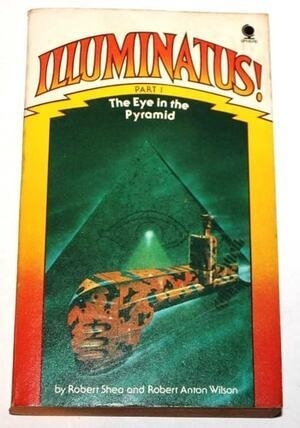
I interrupted Moby Dick because I had a hankering to reread Illuminatus!, which by measure of number of reads must be my favourite book. I blogged about it in 2018 and 2015.
Endless fun, if you’re the type of person that a) rereads books at all, and b) likes spoofs about world-controlling conspiracies that are written in a breezy style that will have you in the mind of a squirrel in Central Park in one sentence and of a hippy journalist in Mad Dog, Texas the next. (I checked: sadly, Mad Dog, Texas is not a real town, though there is a ‘British pub’ called Mad Dogs in San Antonio.)
Just realised I hadn’t added Moby Dick to my ‘currently reading’ list. I’m only about a third in, totally loving it, and wondering why people think it’s hard. 📚
📚 Books 2026, 14: A Canticle for Leibowitz, by Walter M Miller
A Canticle for Leibowitz is one of those books I’ve known of for years, known it was one of the classics of the genre, but never got round to reading, for one reason or another. But it caught my eye in a Canadian bookshop last year, and now I’ve got round to reading it.
I’m not sure I knew it was a post-holocaust work; nor did I know — though maybe the title should have been a clue — that it was so religious. So I started reading it mildly annoyed, I think, and became considerably more annoyed at the end of the first section (of three), when (and spoilers ahead) the main character, whose life in the monastery we’ve been following all this time, is killed.
Well damn. I didn’t expect that.
And then there’s a time jump of several centuries. OK, that’s one of the great things you can do with novels. We’re still with the monks of Saint Leibowitz, mainly, but technology is starting to pick up again. The fractured North America is forming into new kingdoms and tribes.
The third section begins, ‘There were spaceships again in that century…’ Which I really didn’t expect. Several centuries further on, technology’s back up, oh, and hey, we’ve got nukes again! The things that caused all the problems in the first place.
Of course, people know that now, so they won’t use them again, of course. Of course. But better get some monks and priests offplanet to the colonies, anyway. Gotta take the Word of God to the stars.
Which sorta kinda seems to be the message of this book? The Catholic church will endure and Christianity go on, even if The Beatles didn’t? Actually maybe they did, they just aren’t mentioned. It’s not like it was an anti-Lennon tract, it was published in 1959!
Anyway, yeah, it was fine, I didn’t love it. I’m just about to read an erudite piece about it, so I might get back with more.
📚 Books 2026, 13: Keep the Giraffe Burning, by John Sladek
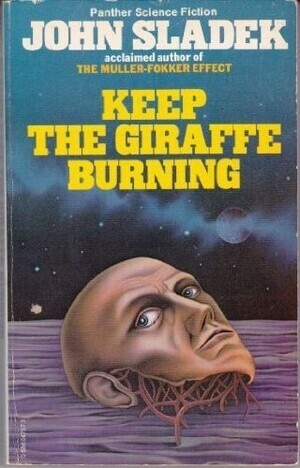
Keep the Giraffe Burning is a collection of Sladek’s short stories, published in 1977 (so nearly 50 hears ago, which is going to take some getting used to). I don’t know when I started reading it, but don’t think it was this year. No matter, though, I finished it the other day, and that’s all that matters for counting it as one of this year’s books.
It’s a strange one. I remember hearing of Sladek as being one of the few writers who successfully mixed SF with humour. I read two or three novels by him, so long ago that I remember basically nothing about them, but I don’t recall them being particularly funny.
The same is true here. They’re surreal, certainly; mildly humorous; but a long way from laugh-out-loud funny. Which is fine. I guess I enjoyed them enough to keep going, but really, I wouldn’t bother with them again.
📚Books 2026, 12: Just One Damned Thing After Another, by Jodi Taylor

I’m not sure where I heard of this. It’s on a list of possible books to read I’ve had knocking around for a few years. I thought it originally came from one of those lists in The Guardian, ‘Books to Read This Summer’, or similar. But I can’t find any reference to it on the site now.
And it would be kind of strange to read about this in The Guardian, because it’s not very professional.
The problem is, it feels like it needs a major editing pass. It’s kind of disjointed. There are inconsistencies of tone, and confusion (in the reader) about how much time has passed. After what feels like quite a short time in the main character’s experiences, we learn five years have passed, for example.
The idea is good, and it does succeed in being a page turner. It wound the tension very high, especially at one point. It’s about time-travelling historians. An academic institute where they do historical research by time travel.
Which is a fine idea, but surely the first question anyone asks when they discover time travel is possible is, ‘To the future?’ So if you’re not going to travel forward you need some mechanism or rule as to why that’s not possible. Our characters here don’t even think about the future. Except (spoiler ahead) when one character reveals he’s from the future.
Later on there’s a mission to Mars planned, but that has nothing to do with our characters, except when one threatens to leave and join the space programme. Other than that we hear nothing of the world outside St Mary’s, the research institute that gives this series (because of course) its title.
It turns out it began as a self-published novel, and was successful enough that the series was picked up by a mainstream publishing house, which is the dream. From reviews and comments on GoodReads and elsewhere I hear the writing gets better in the later books. I suspect that is at least partly because of professional editors. Still, we learn our craft and hopefully improve oner time, whatever we do.
Overall I enjoyed this book, though I’m not sure I would recommend it, and I don’t think I’ll bother with the sequels. Interesting, though.
📚 Books 2026, 11: Bright LIghts Big City, by Jay McInerney

I feel that title should have a comma.
I heard Jay McInerney interview on The Booking Club podcast , and it intrigued me enough to make me want to read this. Then, as I suggested a couple of days ago, I wondered why I hadn’t read it years ago..
The second-person, present-tense viewpoint quickly becomes transparent, and is never annoying.
It’s a cocaine-fuelled fever dream. Over a few days and 150 or so pages our unnamed (I think) protagonist loses his job through general fucked-up-ness, tells us the story of how his wife left his wife left him, and of the death of his mother. Which seems to be main trigger for his fall. This is a telling quote:
You kept waiting for the onset of grief.You are beginning to suspect it arrive nine months later, disguised as your response to Amanda’s departure.
All of which makes it sound dark and tragic. But it’s not. It’s really funny most of the time, and a compelling narrative beautifully written all the time. Overall I enjoyed being in the narrator’s head — or him being in mine, or however you’d put it.
📚 You are reading Bright Lights, Big City by Jay McInerney. You are finding it hilarious. This book was published when you were 20: why have you not read it till now?
📚 Books 2026, 10: The Lost World, by Arthur Conan Doyle
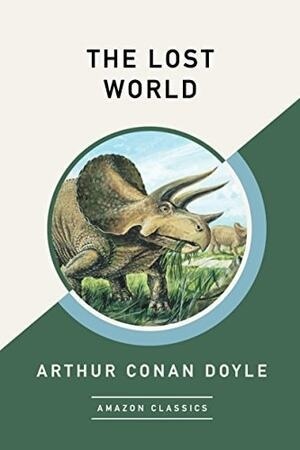
I had read a lot of Sherlock Holmes, but none of Doyle’s other work; including none of the Professor Challenger stories. There aren’t nearly as many as there are Holmes stories, so it’s less of a challenge (ha) to do so. I was in a second-hand bookshop a few weeks back, in an unfamiliar town — let’s not be coy, it was Taunton — and I was there so long, going, ‘So many books, so little time,’ that I felt I had to buy something: it would be impolite not to.
And just as I was preparing to leave, I saw a collected Professor Challenger volume, and here we are. I’m treating the individual novels in it as separate novels, since they are, and will write about them here individually.
So to The Lost World . A tale of adventurers finding a fabled land where dinosaurs still live, even in the 20th century. In this case it’s on an inaccessible plateau in South America, not underground, for example.
In fact, this is the motherlode for all those kind of stories, predating Edgar Rice Burroughs and everyone else.
It’s presented as a work by a journalist, Edward Malone, a young man seeking both to please his editors, and (seemingly more importantly at first) to charm his beloved, one Gladys, who says she’s attracted to the adventurous type of man.
Challenger claims to have seen evidence of the prehistoric creatures' existence; his brother scientists don’t believe him; the Zoological Institute commissions an expedition to confirm or deny. Young Malone volunteers/is volunteered to go along and report back.
Stuff happens. Dinosaurs are found. Ape-men fought. An impossible fecundity of life exists on a twenty-by-thirty mile plateau, isolated from the rainforest and Amazon below it. (A question comes to mind: why wouldn’t the pterodactyls fly down from the plateau to the jungle? At least sometimes?)
It’s lots of fun, if very full of the idea that the white European (or really, British) man is the most highly evolved entity on the planet. It is, of course, of its time.
📚 Books 2026, 9: Disappear Doppelgänger Disappear, by Matthew Salesses
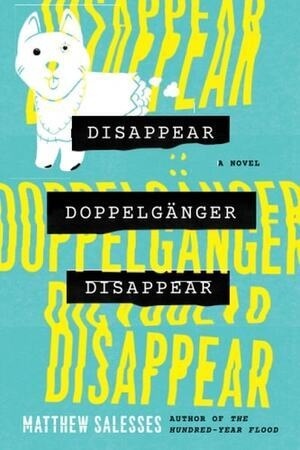
I first heard of Matthew Salesses when I was doing my MA. One of the tutors said his forthcoming book on the craft of creative writing was eagerly awaited by everyone in the business of teaching it. This was in early 2021. I got hold of an ebook copy of Craft in the Real World at some point, and haven’t got very far with it. The main thesis, as I recall, was about the typical method of critiquing creative works didn’t work well for all people.
Which is fair enough, if perhaps a bit slight to hang a whole book on (I’m sure there’s more). But when I was looking into it, I read the announcement of this novel (which came out earlier, in 2020), and thought it sounded amazing.
What’s actually amazing to me, having read it, is that it’s the second novel in a row I’ve read that makes almost no sense at all.
I expect it’s me. I suppose it must be, because again, the cover and inner pages here are festooned with glowing platitudes, while I was left cold by much of the action, and confused by what Salesses was trying to say.
A young Korean-American writer1feels he’s disappearing. A near-duplicate of his girlfriend turns up. She used to have a boyfriend who looked just like the narrator, and who disappeared.
She has never heard of Boston, where the novel is set. Until it switches to the alternative universe where the doppelgänger woman came from, and a city whose name is given as XXXXXX. Why not make up an actual, believable, name, I wondered.
All of which is fine, and could explore some interesting ideas about identity, and indeed tries to. But the narrator is such an annoying character who keeps doing stupid things for no very good reason, that it’s hard to get with him. That in itself could be seen as good characterisation, of course.
But whatever is going on between the two alternatives doesn’t make much sense to me, and things don’t get resolved in any meaningful way, and I just didn’t enjoy it much. Cultural differences, maybe? That is, I believe, part of what Salesses’s Craft book was about: different cultures have different ways of telling stories. Maybe my understanding and expectations are just too western to appreciate this.
Which is my loss, I guess.
-
Just because they say ‘Write what you know’ doesn’t mean you have to write about writers, by the way. ↩︎
📚 Books 2026, 8: The Spirit of Science Fiction, by Roberto Bolaño, Translated by Natasha Wimmer

On the cover of this there is a quote from The New York Times describing it as ‘A gem-choked puzzle of a book.’ Which is a very fair point. I ended this book and said, ‘I didn’t understand that.’ Which has nothing to do with its being in Spanish, as I was reading a very good translation.
I didn’t really get what it was trying to say, what the point of its existing was. Which sounds horribly dismissive, and I don’t mean it that way. I enjoyed it while I was reading, which didn’t take long, as it’s only 196 pages. But the ending…
Well, let’s start at the beginning. It’s a novel by a Chilean author who is very well thought of, at least posthumously. It’s about two twenty-something would-be poets from Chile, recently arrived in Mexico City. It has three strands. One is a fairly straightforward telling of their life, from the point of view of one of them, Remo. Trying to find writing workshops, learning about the literary magazines of their adopted city, partying.
In another strand, someone is interviewing someone else. The interviewee appears to be Jan, the less active of the two poets. In that first strand, it’s clear he hardly leaves their room. But in this one he has just won a major award. The interviewer may be Remo, but it’s never stated, and there are suggestions it’s someone else.
And in the third strand, Jan writes letters to real-life science fiction authors. Alice Sheldon, Ursula LeGuin, Philip Jose Farmer, and others. They are partly fan letters, partly weird philosophical discussions.
And that’s more or less it. They both get girlfriends, Remo gets a motorcycle. The book ends with a section entitled ‘Mexican Manifesto’, which describes Remo and Laura’s experiences in the bathhouses of the city. And then it just… stops.
Honestly, I feel as if there’s a whole chunk missing at the end. Especially since there are no pages after the last one, either with information or even blank, which is quite unusual.
Another review comment, from the Paris Review, says this book ‘functions as a kind of key to the jewelled box of Bolaño’s fictions’. So maybe I need to read more of his books, and I’ll understand them collectively?
A couple of reviews linked from the Wikipedia entry suggest strongly that this — an early draft, not published in Bolaño’s lifetime — was indeed the wrong place to start.
📚 Books 2026, 7: Raven Black, by Ann Cleeves
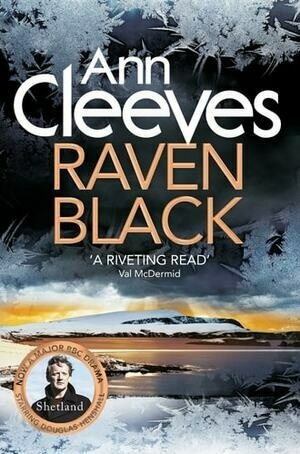
I heard Ann Cleeves on the Radio — probably Radio 3’s Private Passions — a couple of years ago. I must have seen her books in shops before that, but hadn’t really paid attention. And I vaguely was aware there was a BBC detective show called Shetland.
Turns out that show is based on this novel and its sequels.
Anyway, she sounded interesting on the radio and I seem to read almost as much crime fiction as SF these days, so when I was exploring a bookshop on our recent trip to Devon, and saw this, I thought I’d give it a try. I devoured it in a couple of days. Really good page-turner, engaging characters, unexpected ending, Just what you want.
📚 Books 2026, 6: The Twenty Days of Turin, by Giorgio De Maria, Translated by Ramon Glazov

I don’t recall where I first heard about this . It was probably Warren Ellis, but I seem to recall there being a second source. Anyway, I lived in Turin, or between Turin and my then-home in Walthamstow, for the best part of a year, 1989–90. My employers had a big contract with an Italian bank, and most of the work was done on site. Which seems amazingly old-fashioned for software development today, when we mostly don’t even visit our employers' premises very often.
All of which has nothing to do with the novel. It was written in the 70s and is set then. The unnamed first-person narrator is researching the titular event, which happened ten years earlier. It’s not entirely clear to what extent he experienced the ‘Twenty Days’ himself, but many people still living in the city did, and they don’t talk about it. It started with mass insomnia. Sleepless people took to the streets, some in their nightclothes. Then the violence started. Mysterious, brutal murders of the insomniacs.
But before all that, there was the Library. It seemed to be a project by well-meaning young people, possibly religious, who set up a kind of pre-computer social network. People were encouraged to share diaries or other writing — original manuscripts only, no published work. For a small fee, anyone could visit the archive thus formed, and read any of the pieces. For slightly higher fee, they could find the name and address of a chosen contributor.
The idea being ostensibly to help lonely people find like-minded folks. With a strange inevitability, that isn’t necessarily how it was used.
The implication is the Library somehow led to the sleeplessness, if not the violence. Perhaps not the violence, as our narrator’s explorations appear to find a more supernatural, if not downright bizarre, explanation for that.
And it all seems to be starting up again. The Library didn’t go away, it just went underground. And the narrator and at least one of his interviewees may be in danger.
It’s an odd one this. Reviews of the recent English-language publication speak of its prescience, comparing the combination of the Library and the insomnia with people up all night doomscrolling on their phones. Which is interesting, but takes no account of the violent attacks, and the supernatural element.
I think this will bear repeated readings.