
📚 Books 2026, 4: Caledonian Road, by Andrew O'Hagan
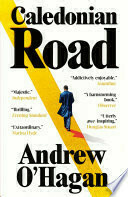
I really enjoyed this. It’s set in London (mostly), in a later year of the pandemic (2022, probably), and across just over a whole year. The characters are people from the upper-middle to upper classes, and some of the lowest classes in society, including criminals and illegally-trafficked people who have to work for them.
Some of the blurbiness on the cover describes it as a ‘state of the nation’ novel. It doesn’t quite seem like that for me (though I don’t know if I could give you an example of one that is), not least because the main characters exist at a fairly rarified level of society. They are things like academics, authors, journalists, MPs and lords. Or else they’re would-be drill rappers in street gangs. There’s nobody who’s just normal; whatever that means.
There are so many characters that O’Hagan provides a list of them, a dramatis personae, which I approve of.
Anyway, it’s very good, and I read it much faster than I expected to, which is usually a good sign.
Ed Zitron’s latest, On NVIDIA and Analyslop, is very good on the current state of some financial stuff related to ‘AI’. It’s also good on how much more complex software development is than the ‘vibe coding’ believers would tell you:
Software is a tremendous pain in the ass. You write code, then you have to make sure the code actually runs, and that code needs to run in some cases on specific hardware, and that hardware needs to be set up right, and some things are written in different languages, and those languages sometimes use more memory or less memory and if you give them the wrong amounts or forget to close the door in your code on something everything breaks, sometimes costing you money or introducing security vulnerabilities.
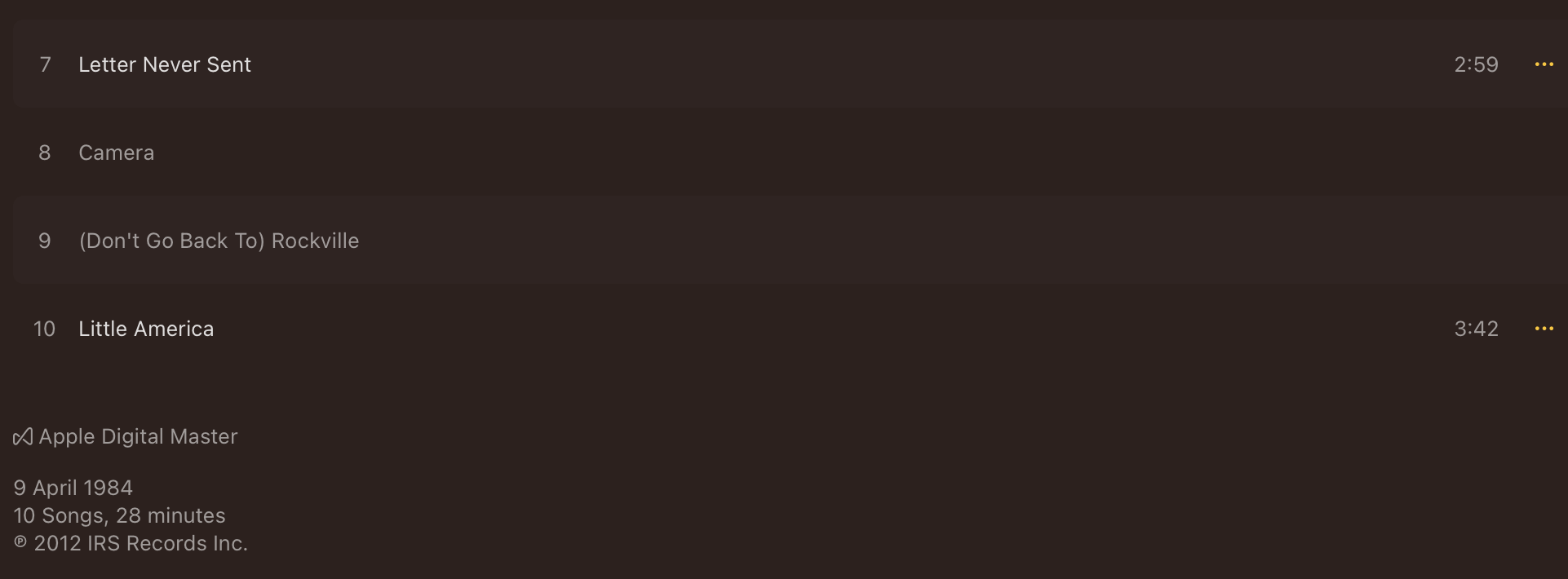
Fuckin hell, Apple Music! This is just what I was talking about a few weeks ago. ‘Camera’ and ‘(Don’t Go Back To) Rockville’ just aren’t going to play, for no reason.
A quick note just to keep up my streak of having posted every day this year. Is that stupid? Maybe. Will mentioning it jinx it? Time will tell.
Automatic Introspection
On texts created by prompts. If you can express your meaning in a prompt, why not just send out the prompt?
Watched: The Eagle Has Landed 🎥
if you’d have asked me I’d have said I thought I’d seen this back in the day. But no. Very much not. It’s a very odd film.
I thought it was going to be about some allied mission into or over Germany during WW2. It was actually the opposite: a secret German mission to kidnap Churchill from Norfolk. Including an IRA member helping them, and a traitorous English villager providing them with information.
it’s so totally not what I expected, but it’s pretty good.
Fun Minute Cryptic clue today.
Minute Cryptic - 20 February, 2026 “Dropped Jacksonville’s latest quarterback after non-pass?” (4) 🟣🟣🟣🟣🟣🟣🟣 🏆 0 hints – 2 under the community par (71,660 solvers so far). www.minutecryptic.com
Watched: Ludwig Season 1 🎥
This was unexpected, and surprisingly good. David Mitchell playing a semi-serious (but still fairly comic) part, as a puzzle-setter whose twin-brother police officer goes missing. Anna Maxwell Martin as his sister-in-law. Good stuff.
Ablative Irony
Also via Kottke comes this article by Claudio Nastruzzi at The Register, where he talks of ‘semantic ablation’ in text generated by ‘AI’:
When an author uses AI for “polishing” a draft, they are not seeing improvement; they are witnessing semantic ablation. The AI identifies high-entropy clusters – the precise points where unique insights and “blood” reside – and systematically replaces them with the most probable, generic token sequences. What began as a jagged, precise Romanesque structure of stone is eroded into a polished, Baroque plastic shell: it looks “clean” to the casual eye, but its structural integrity – its “ciccia” – has been ablated to favor a hollow, frictionless aesthetic.
It’s about how LLMs — probability-based machines, after all — tend to push text in a generic direction, away from a writer’s unique voice, towards a common mean.
So let’s all not do that.
The irony is, I was trying to look up an unfamiliar word in that quote — ‘ciccia’. The dictionaries installed on my Mac had nothing useful, and nor did Wikipedia. DuckDuckGo’s search only came up with uses of the word as a family or brand name. I used the ‘!g’ syntax to send the query to Google.
It must be the first time I’ve had to do that in quite a while. I’ve heard people mention — complain about — the ‘AI Overview’ the Big G provides, but I’m not sure I’ve every seen it before now. But it was what had the answer:
informal Italian term for meat or, idiomatically, body fat (flab).
Clearly Nastruzzi is using it as we might say ‘the meat of an argument’, or similar.
Google’s AI thing does not cite its source, though, and none of the next few search results give a reference for that use in English, though one is to the meaning of the Italian word.
Anyway, my recommendation to all fellow writers, would-be writers, and people who want to or have to communicate by writing: express yourself. Don’t let American machines do it for you (and use as many em-dashes as you need, as I have done here).
Question being asked on BlueSky (saw it from @kottke.org: ‘Not big movies, more culty ones’) about what movies you saw on first-run at the cinema. Mine, actually premieres at the Edinburgh Film Festival back in the day:
- The Company of Wolves
- Repo Man
- Brazil
The latter two being two of my all-time faves.
Watching the Women’s Freeski Big Air final. They’re such incredible athletes. And Kirsty Muir, from Aberdeen, is currently in the silver medal position! (Briefly was gold, but changed as I was typing.)
Francisca Sinn: “@jamie I am an IP lawyer and…” - Mastodon
This Mastodon post reminds me that what I quoted Cory on the other day, regarding copyright in ‘AI’ training, may not be the whole story. Of course.

📚 Currently reading: Caledonian Road by Andrew O’Hagan.
Looks like the Micro.blog book search is working again.
I’ve been trying to post that I’m currently reading Caledonian Road by Andrew O’Hagan. But the Micro.blog bookshelves tool is not finding it in its database for me. Or finding any other books. Something’s wrong.
Asbestos Intrusions
AI is the asbestos in the walls of our technological society, stuffed there with wild abandon by a finance sector and tech monopolists run amok.
Cory Doctorow’s latest piece is the script of a talk he gave on ‘AI’, or more specifically, ‘how to be a good AI critic.’ He’s writing a book on the same subject.
I found it weirdly comforting in one specific area. That of the supposed copyright-infringement of the training of LLMs. Cory explains why it did not, in fact, infringe copyright:
First, you scrape a bunch of web-pages. This is unambiguously legal under present copyright law. You do not need a license to make a transient copy of a copyrighted work in order to analyze it, otherwise search engines would be illegal. Ban scraping and Google will be the last search engine we ever get, the Internet Archive will go out of business
And he goes on from there, explaining why the subsequent steps in training also do not infringe. Some would disagree, of course, and many would say they put their work on the web with a ‘Not for commercial use’ type of licence, such as a Creative Commons one.1
Which is fair enough too. I don’t think many would disagree with the idea that using the web to train these things was unethical; even more so with using pirated books. But it wasn’t strictly in violation of copyright (at least the current state of US copyright).
Why do I find that comforting? What I mean is, it removes or slightly reduces one of the reasons to be opposed to, or appalled by, these prediction machines, which I alluded to in one of my earlier thoughts about the matter. And in doing so maybe helps me in my quest to understand my own feelings, by at least reducing the number of things I have to consider.
Something like that, anyway. Read the whole of Cory’s piece, it’s very good.
-
I have done so myself in the past, though my site doesn’t currently show any licence. ↩︎
Essentials Playlist, Allegedly
This was an Apple-Music-generated playlist. It considers the following to be my ‘essentials’, as of yesterday.
- The Fall — Kicker Conspiracy
- The Velvet Underground — White Light/White Heat
- James — What For
- John Cale — Fear Is a Man’s Best Friend
- The Beatles — I Am the Walrus
- Joe Strummer — Gangsterville
- Warren Zevon — Something Bad Happened to a Clown
- New Order — Your Silent Face
- David Bowie — The Motel
- Kenickie — Spies
- Big Country — Harvest Home
- The Stranglers — Dagenham Dave (1996 Remastered Version)
- 10,000 Maniacs — My Mother the War
- Cocteau Twins — From the Flagstones
- Wet Leg — Convincing
- Radiohead — Anyone Can Play Guitar
- Sonic Youth — What We Know
- The Long Blondes — Separated By Motorways
- Arctic Monkeys — A Certain Romance
- Ramones — Baby, I Love You
- The View — Same Jeans
- Stiff Little Fingers — Go For It (Remastered)
- Grizzly Bear — While You Wait for the Others (BBC Maida Vale Session)
- The Big Pink — Dominos
- Thea Gilmore — Heart String Blues
I can see where it’s coming from, to a degree. The Fall, of course, and I’ve been playing them a lot recently for reasons I’ll go into later. Joe is there (though not The Clash), The Velvets, John Cale on his own (though not Lou). James, SLF of course (but the strange choice of their only instrumental).
All fine. Odd choice of Bowie track, but then, I did play through all his later albums recently, for reasons that I also might go into later.
10,000 Maniacs, though? I hardly know the track (though I like it), and I don’t think I’ve ever listened to an album by them. I don’t much like Arctic Monkeys, though that song is fine. But the Grizzly Bear one? I don’t think I’ve ever heard anything by them, including that one.
Oh yeah, and a very odd choice of Warren Zevon track.
It closes well, though: I love that Thea Gilmore track.
But you’ve got to wonder what goes into the algorithm that generates this kind of thing.
Minute Cryptic - 10 February, 2026 “For example, an elephant over 50 reproduced three times” (10) ⚪️🟣🟣🟣🟣🟣🟣🟣🟣🟣🟣🟣🟣 🏆 1 hints – 4 under the community par (95,093 solvers so far). www.minutecryptic.com
Minute cryptic’s a scunner today. But good maths.
I’m listening to the current Accidental Tech Podcast to see what they actually say about ’AI’ after much recent Mastodonage about it and them.