
Longform
The Hydrogen Sonata by Iain M Banks (Books 2022, 19)
The last of the Culture books and Banksie’s SF books, both at all, and that I had only read once.
The odd one about this, as a Culture book, I realised only very late on, is that neither Special Circumstances nor even Contact are involved, directly. Just a random grouping of ships who take an interest in the matter.
The matter in question being the decision of a species called the Gzilt to sublime, or leave the material realm for higher dimensions. This a common endpoint (or new beginning) for civilisations in the Culture universe, and I wonder whether, had Iain lived, he would have taken us to the point where The Culture itself was making that decision.
Anyway, the sonata in question is one that is barely playable because it was written for ‘an instrument not yet invented’, which turns out to be be the Antagonistic Undecagonstring, or Elevenstring. An instrument with some 24 strings (some not counted in the name, because they are not played, they just resonate) designed to be played with two bows simultaneously.
Our hero — or at least, the main humanoid viewpoint character — Vyr Cossont, has been surgically adapted to have an extra pair of arms to allow her to play it. It is still next to impossible, but she has made it her ‘life task’: something to do while waiting for the day when your civilisation sublimes. The decision for them to go was made long before she was born.
But her playing the sonata is only a side issue. The real problem is that maybe someone is trying to sabotage the sublimation. Or maybe not, but odd things are afoot, and various people and ships get involved, and it’s all a whole shitload of fun.
The Situation and the Story by Vivian Gornick (Books 2022, 18)
On my MA course, in the Creative Nonfiction module, we were assigned the first chapter of this as one of our readings. It intrigued me enough that I ordered a copy.
Pages of Hackney had to order it from the US, and it took a long time to arrive. The module (and possibly the course, though I don’t actually think so) had finished by the time it arrived.
It took me even longer to finish reading it, despite it being a very slim volume.
It’s subtitled ‘The Art of Personal Memoir’. She starts one section by saying:
Thirty years ago people who thought they had a story to tell sat down to write a novel. Today they sit down to write a memoir.
And it was published in 2001, so she was seeing a change since the seventies. That may be even more true now, as creative nonfiction, memoir, the confessional story: that’s a huge publishing category.
But I’m not sure to what extent this book will help people who want to sit down and write one.
Gornick likes to teach by example. I would estimate that between 40 and 50% of the words in this book are other people’s. All properly cited and credited, of course, and the relevant permissions listed at the back. But she uses huge long quotes.
Nothing inherently wrong with that, of course. How else do we first learn to write at all, other than by the examples of things we read? But I felt she spent too much time quoting the examples, and not enough explaining why she chose those. I don’t know, maybe use smaller examples, or break the big quotes up with interjections on technique.
Early in the book she talks about the nonfiction writer:
Here the the writer must identify openly with those very same defenses [sic] and embarrassments that the novelist or the poet is once removed from. It’s like lying down on the couch in public … Think about how many years on the couch it takes to speak about oneself
The casual synecdoche of ‘couch’ to mean ‘therapy’ or ‘analysis’ amused me. So commonplace must analysis be in her circles, that she assumes everyone knows what ‘lying down on the couch’ is like. Whereas most of us, I would guess, only know about it from seeing it in films.
Interzone Issue 292/293 Edited by Andy Cox (Books 2022, 17)
Not strictly a book, but a double issue of a short-story magazine seems substantial enough to treat as one.
I don’t know when the last issue came out, but I had actually forgotten that I still had a subscription. It was good to get this, not least because it’s going to be the last to be edited by Andy Cox and published by TTA Press — Interzone 2.0, we might call it, after the David Pringle years.
From the next issue the editor will be Gareth Jelley, and the publisher MYY Press. The surprising thing about that is that the press is based in Wrocław, in Poland. Which is odd because then, is it a British SF magazine anymore?
That probably doesn’t matter, because of course it’s an international genre, and it’s not like they ever only published British writers. But still, quite a dramatic shift. It’ll be intersting to see how the magazine changes.
I enjoyed this a lot. There was perhaps too much Alexander Glass1 — three stories and an interview — but I guess sometimes you have a special focus for an issue (or two). And they’re all good.
Several of the stories suffer from something I’ve complained about before, which is to say, they don’t have endings. Or, put another way, the authors chose to end them at a point that I find unsatisfying; or I don’t understand why they chose to end there.
But in this case, I don’t think any of the ending-choices let the stories down too. much.
-
Who weirdly doesn’t seem to have a website. Or at least, I can’t find it, and it’s not linked from his Twitter, which is what I’ve linked to here. ↩︎
We're No Angels, 1955 - ★★½
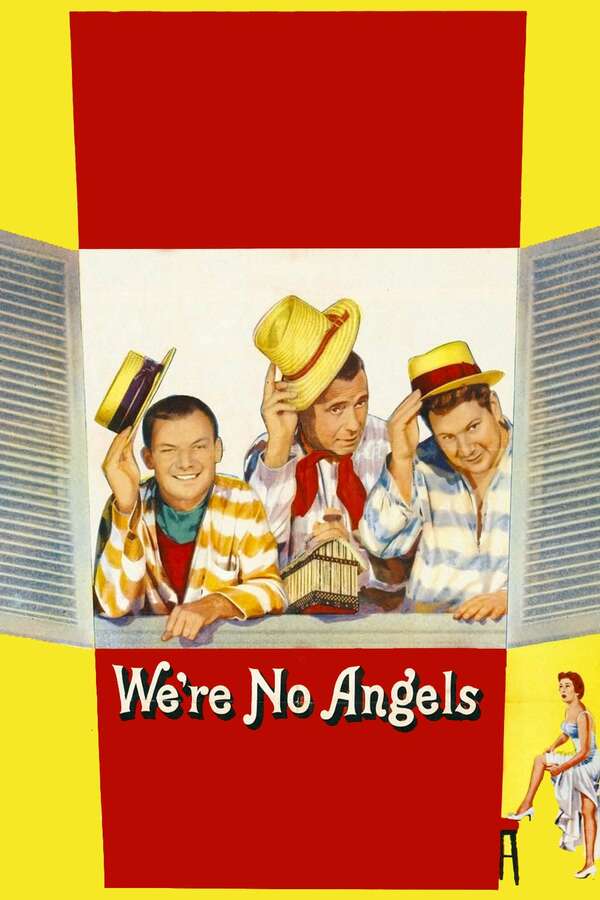
Daft wee film — a Christmas film, I was surprised to realise — from 1955 in which Humphrey Bogart and Peter Ustinov or two of three prisoners who’ve escaped on Devil’s Island.
Their escapades are odd, and the ending is not quite as predictable as I expected.
An odd one, but enjoyable enough.
The Computer Connection by Alfred Bester (Books 2022, 16)
This starts out with the main character escaping from some obscure threat and reaching a friend’s place. The friend sends him into the past — so you think it’s going to be a time-travel story. In the past he tries to save a struggling artist by giving him gold.
And that’s the last we hear of time travel. It’s actually a story of humans who have attained bodily immortality through various traumatic incidents, and things going on with them. There’s some space travel, and, not surprisingly given the tite, a computer connection.
It’s pretty strange in the way that Bester can be. Not one of his best, but interesting enough. Harlan Ellison praises it — and Bester — highly in the introduction.
I had one of those, ‘Have I read this before?’ experiences through the first few chapters, but it soon stopped. So I wonder if I started it once before. If so, I don’t know why I’d have stopped, as it kept me going this time.
The Islanders by Christopher Priest (Books 2022, 15)
I’m not sure that I’ve read any of Priest’s ‘Dream Archipelago’ stories before now. Certainly the ones that I’ve tagged with his name are all outside of that loosely-connected set. But you can’t have been interested in SF as long as I have and not be aware of it.
This one, though, well.
Its conceit is that it is a gazeteer of the Dream Archipelago (which is, I’m slightly surprised to discover, what its residents call it: I had thought it was more… dreamy than that).
The archipelago is essentially impossible to map, because of some kind of time-distorting vortices that occur over the world it is on. No one is sure how many islands there are or the names or locations of even the main ones. The writers of the gazeteer try their best in any case.
By way of the would-be-factual entries, plus a number of fairly straightforward short stories (which don’t fit the gazeteer format, but then nothing really ‘fits’ here) we get something of the backstory of the archipelago, and fragments of the lives of a few of its prominent citizens.
It’s all highly readable and makes me want to know more about this odd world and its people (who seem to be essentially human).
Still Life by Val McDermid (Books 2022, 14)
‘A Karen Pirie thriller,’ the description on the cover says of this. I’m not sure ‘thriller’ is quite the right term. It’s exciting enough, but there isn’t the tension that would take it up to ‘thriller’ level. Not least because Karen Pirie is never in any danger, other than possibly pissing off her boss, the deputy chief constable of Police Scotland.
I’ve never read Val McDermid before, so picking up one of her later ones — possibly her latest: published in 2020, set just before the pandemic, and ending as lockdown starts — would be a strange choice. But sometimes you’re in a holiday house and there are some books and it’s not so much a choice as an offering. I’ve fancied checking out some tartan noir for a while, anyway.
It’s good. I enjoy a crime novel from time to time, and this one certainly kept the pages turning. Backstory was filled in very efficiently, without it feeling like infodumping. And reading about the chill autumn in Scotland (with slight detours into France, the north of England, and Ireland) took the edge off some of the Greek heat.
The title is a little confusing. There is some art involved in the story, but none of it is a still life. There’s at least a double meaning to the phrase, of course, and that makes sense in context. But maybe the French term, nature mort, is even more applicable. Not least since Karen Pirie works cold cases for the Scottish police force.
A Theatre for Dreamers by Polly Samson (Books 2022, 13)
Greece is probably the best place to read this novel, which is good, because that was where I was when I read it. It’s a work of fiction mostly set on the real island of Hydra during 1960-61. There was a famous community of anglophone expats there at the time, one of whom was Marianne Ihlen. They were notably joined by Leonard Cohen.
The first-person narrator is fictional, but nearly every other character is real. It’s an unusual approach for a contemporary novel, though perhaps not for historical fiction. Which, at sixty years distance, you could consider this. Some of the people are still alive, though, which is probably what makes it feel a bit odd.
Not Leonard or Marianne, though. The books starts with the narrator visiting Cohen’s old house on the morning after his death was announced. Which — and I had forgotten this — was just after Trump got elected. Everything else is flashback.
It’s very good. Captures the feeling of a Greek island summer, the listlessness of the young drifters, and the bitterness of the older writers who still struggle for success.
Software and Wetware by Rudy Rucker (Books 2022, 11 and 12)
Or the first two books in the Ware tetralogy, as they now are. I read Software many years ago, and enjoyed it, though not as much as some of Rucker’s others, notably White Light.
This time round it was fine, and so was the second one, but not really anything to write home about. I’ll read the other two, since I’ve got the combined edition on my Kindle, and they’re not very long. But there’s a spark that Rucker has when he writes about things like infinities, that just isn’t there when he writes about the themes here.
Which are artificial intelligence, machine sentience, and the possibility of transferring human consciousnesses into robot bodies and vice versa. Those are fascinating concepts, but the stories don’t quite jump off the page enough for me.
Ubik by Philip K Dick (Books 2022, 10)
I had associated this in my head with Dick’s VALIS, which is one of his latest works (written 1978, published 1981, according to Wikipedia). I think just because of the similarity of names.
Ubik is in fact more of a mid-period novel (written 1966, published 1969), and it shows. Though according to the Wikipedia entry, ‘it was chosen by Time magazine as one of the 100 greatest novels since 1923.’ I find that a tad surprising, as it’s far from one of his better ones to my mind.
Certainly some of his tropes are there: strange warps to reality, confusion over who is and isn’t dead, that sort of thing. But it’s just not as compelling as, say, Flow My Tears, the Policeman Said, or A Scanner Darkly; nor as weird and fascinating as VALIS.
The characterisation is weak — which is probably true for most of Dick’s work, to be fair. But the story just doesn’t really get off the ground.
Firefox Rolls Out Total Cookie Protection
Starting today, Firefox is rolling out Total Cookie Protection by default to all Firefox users worldwide, making Firefox the most private and secure major browser available across Windows, Mac and Linux. Total Cookie Protection is Firefox’s strongest privacy protection to date, confining cookies to the site where they were created, thus preventing tracking companies from using these cookies to track your browsing from site to site.
– Mozilla, Firefox rolls out Total Cookie Protection by default to all users worldwide
Sites can only see their own cookies. This is the way the web should always have been.
I’m forgetting my netiquette: I should have said, via Ben Werdmüller.
Bloody Ebooks!
I read Inverted World on the Kindle. It always annoys me that you’re put at the start of the text on opening. I like to go back to the cover and work forward. Sometimes I use the contents links for that, and I think I might have done so here, skipping the introduction, because they nearly always contain spoilers.
So I started with the famous opening sentence I wrote about. But because I linked to the book’s Wikipedia page, I skimmed the article. Which mentioned a prologue, that I had somehow missed.
As it happens, missing the prologue didn’t really matter, didn’t affect my enjoyment of the book. But first, I don’t know how people can refer to the first sentence of Chapter 1 as the opening sentence, when there’s a prologue full of sentences before it.
And second, be careful how you read your ebooks. You might miss something.
Inverted World by Christopher Priest (Books 2022, 9)
With its fairly famous opening line — ‘I had reached the age of six hundred and fifty miles.’ — I kind of thought I had read this before, long ago, maybe as a teenager. But no. It turned out definitely not.
A young man learns his place in a city — Earth City, as they call it — which is moving. Rails are placed before it and lifted up behind it so they can be laid in front again. The city is winched along on the rails by fits and starts. Why? Why is it in motion, and why do the inhabitants work desperately to keep it so? And why is the fact kept hidden from city dwellers who are not ‘guildsmen’?
The answers, or some of them, are within. Though there is no answer to why ‘guildsmen’ is the correct word. Women are second-class citizens in the city. And worse outside it, on the whole.
The people of the city are human, they speak English mostly. They know their ancestors were from Earth planet, as they refer to it. The people in the villages they pass also seem to be human, and they mostly speak Spanish. The sun appears not as a sphere, but as a kind of disk with spikes top and bottom. What can be going on? The title suggests some kind of inversion, but what is it?
Ultimately the mystery isn’t solved in a very interesting way, and the ending is sad, but maybe happy, but maybe sad.
Priest has written much better books, but it bears reading.
The Absolute Book by Elizabeth Knox (Books 2022, 8)
This was prompted by a Guardian article — listicle, you might say, since it’s basically a big list — of books for the summer (last summer): Summer reading: the 50 hottest new books everyone should read. I borrowed it from my local library. Kind of great that you can borrow ebooks from the library. Especially during lockdowns, when the buildings themselves were closed.
It is a magic realist novel set mostly in Britain and faerie; or the sidhe, as it’s called here. It starts with the story of the tragic death of the main character’s sister, when they were both in their late teens or early twenties. Was it murder? certainly the driver of the car that killed her was imprisoned.
The loss of her sister haunts Taryn’s life, predictably. But if there are hints that the death is somehow linked to the other mysteries that run through the book, then it is never satisfactorily resolved that there is or isn’t any connection.
That aside, we soon find ourselves — unexpectedly, for me at least — in another world. It seems that all the otherworlds exist: Munin and Huggin, Odin’s ravens, turn up. We hear that ‘The Great God of the Deserts’ went mad because his believers had too many different ideas of what he was like, so heaven is closed. A visit to purgatory is made.
Taryn finds out she is damned, because of an action she took — or didn’t take, a sin of omission — regarding her sister’s killer. And seems to accept this, and another evil at the heart of the Sidhe, without trying to understand it, without raging against it.
It’s good, but there are definite weaknesses. I found the action scenes very confusing. Some of the geographical descriptions, too. And it feels a bit… maybe unfocused is the word? Hard to say what exactly I mean by that, but I guess it’s that some things are hinted at when they should be explained. At least eventually.
There are a few oddities. It’s set mostly in Britain, but some Americanisms creep in where they wouldn’t. Can’t think of any specific examples, but it’s on the level of saying ‘highway’ instead of ‘motorway’. That kind of thing.
Well worth a look, though.
Musky Times
I wasn’t going to write anything about Elon Musk buying Twitter, because I mostly don’t care. But Robin Sloan, in his newsletter, which isn’t really a newsletter, because he just sends a link to a blog post (with a few added words), says this:
An industrialist intends to purchase Twitter, Inc. His substantial success launching reusable spaceships does nothing to prepare him for the challenge of building social spaces. The latter calls on every liberal art at once, while the former is just rocket science.
I wanted to quote that because I loved ‘just rocket science.’ The common expression, ‘It’s not rocket science’ has always mildly amused me, as a physics graduate. Because rocket science is relatively both simple and easy. It’s straightforward Newtonian physics. Mass. Acceleration. Forces. The physics is simple, the sums are easy.
You don’t have to go anywhere near even Special Relativity (still straightforward, if harder), General Relativity (much more complex), or of course anywhere close to quantum physics (frankly the most complex and confusing thing of all).
All of which is just to say that physics has more and less difficult areas. Rocket engineering, of course, is quite another matter. There you’ve got all sort of complex materials science, chemistry, end even — if crew are involved — biology, sociology, psychology. Those are much harder.
As far as common similes for the ease of something go, I’ve always preferred ‘It’s not brain surgery.’ If I think about it I’m amazed that operating successfully on a living human brain is even possible, and I bow my head to those who can do it. While hoping they’ll never have to go near said bowed object, of course.
Anyway, that would have been that for this post, except that I pasted the above quote from Sloan into a text editor. But it didn’t look like it does above. It looked like this:
An indus-tri-al-ist intends to pur-chase Twit-ter, Inc. His sub-stan-tial suc-cess launch-ing reusable space-ships does noth-ing to pre-pare him for the chal-lenge of build-ing social spaces. The lat-ter calls on every lib-eral art at once, while the for-mer is just rocket science.
Where did all those hyphens come from? They look like they’re non-printing characters. Ones that won’t show up when a web page is rendered, but are there in the source code. Why? I can only imagine two reasons:
- a deliberate ploy to make it harder to copy quotes, as I have done above. But Sloan is a pro-web kinda guy, as far as I can tell. It doesn’t seem like something he’d do.
- A glitch. An artifact of the software he used to create the post. It’s most likely that. Weird one, though.
Stranger still is that the character is not even a hyphen. As I discovered when I search-and-replaced it in BBEdit, it actually appears to be this: \x{AD}.
I don’t even know what that is. Some kind of hexadecimal representation of something. An invisible hyphen, presumably. Which I had to search-and-replace with actual hyphens to make them visible above. Looking at the source code, it’s written as the HTML entity ­, which the DuckDuck tells me is a ‘soft hyphen’.
All very odd.
I have positive feelings about Sloan, except for his closing image. I’ll risk another paste:
Wishful descriptions of Twitter as “the de facto public town square” or “the closest thing we have to a global consciousness” sound, to me, like Peter Pan begging the audience to clap and raise a swooning Tinkerbell.
You don’t have to clap.
Yeah, but… of course you have to clap. Without wanting to get all metaphysical on you, if you don’t clap when Tinkerbell is dying, you’ve got no soul.
Luckenbooth by Jenni Fagan (Books 2022, 7)
This came to me by way of The Guardian’s summer reading recommendations last year. I ended up reading it in the tail end of winter, or spring, but that doesn’t matter. In his review, M John Harrison describes it as ‘brilliantly strange’, and that’s about right.
It’s a tale told across times, and tied to place. That place is number 10 Luckenbooth Close, in Edinburgh. Just off The Royal Mile, in fact, which is a place I lived as a student. I was in an alley called James Court, though, not the fictional Luckenbooth Close.
The close may be fictional, but the idea is not: luckenbooths were a kind of market stall in the High Street (part of The Royal Mile). Presumably that’s where Fagan got the street name from.
Though I discover today that a luckenbooth is also a piece of jewellery: a kind of heart-shaped brooch , named after the market stalls in turn.
The book, though, is about none of those things. Instead it’s about a series of people who live in the titular tenement block across the centuries. We start with the Devil’s daughter, who — well, I won’t go into spoilery details. William Burroughs is one of the characters, strangely. Apparently he did visit Edinburgh.
It is an astonishing work, involving the saving of ghosts, murders, the Millennium celebrations, homelessness, and much more. Highly recommended.
The Schrödinger's Cat Trilogy by Robert Anton Wilson (Books 2022, 4–6)
Yes, all I do is reread. Sometimes it seems that way, anyway. Well, it was the end of 2014 when I read this last. Seven and a quarter years seems fair. It’s a lot of fun, which is why I keep returning to it, I guess.
The missing scientists, that I mentioned last time? True, it’s never explicitly explained where they went, but I think it’s clear that they found out how to move into other worlds, and went off to visit next-door universes.
The three volumes are entitled The Universe Next Door, The Trick Top Hat, and The Homing Pigeons, by the way.
I’m still making my way through the mammoth book that I mentioned before, but slowly. It’s The Books of Jacob, by Olga Tokarczuk, and you’ll read about it here eventually.
Propaganda and Suffering
I’ve seen a strange set of opinions popping up on Twitter over the last week or so, essentially blaming the US, the UK, and/or NATO for Putin’s illegal and horrifying war on Ukraine. Which on the face of it is bizarre, at best.
It’s possible that NATO’s expansion over the last couple of decades was unwise. Yet who could blame small countries close to Russia from seeking the protection that membership brings? Putin’s belligerence was well known even before the current attack.
George Monbiot makes the point well in his excellent Guardian piece:
There is a strong argument that Nato should have been disbanded at the end of the cold war. But while Putin’s sense of threat seems to have been heightened by Nato expansion and mission creep, Nato expansion has also been driven in part by Putin’s belligerence. Are we really to believe that Estonia and Latvia joined because they wanted to attack Russia? On the contrary, it’s because they fear attack. While Nato’s growth is likely to have contributed to the crisis, it’s ridiculous to suggest that Russia is not the aggressor.
– George Monbiot, We must confront Russian propaganda – even when it comes from those we respect
He suggests that Russian propaganda is at least partly to blame. It seems have made inroads on the left. Monbiot mentions the Stop the War Coalition, which normally we would think is an admirable goal and organisation. But their recent letter claims the British government ‘have poured oil on the fire throughout this episode.’ I’m no supporter of Johnson or the Tories, but I don’t think that’s fair. They also say that they ‘do not endorse the nature or conduct of either the Russian or Ukrainian regimes.’
I don’t know what the Ukrainians have done except prepare to defend themselves, and then do so. I’m as against war as any former CND member from the eighties, but when a country is invaded, it has a right to fight back.
Monbiot says it well:
True anti-imperialism means opposing not only the west’s imperialism, essential as this is. It’s about opposing all imperialism, whether western, Russian, Chinese or other.
– George Monbiot, As before
As always, of course, it is the ordinary people who suffer. I recommend donating if you can, to one of the organisations working to help the people of Ukraine:
The Velvet Underground, 2021 - ★★★★
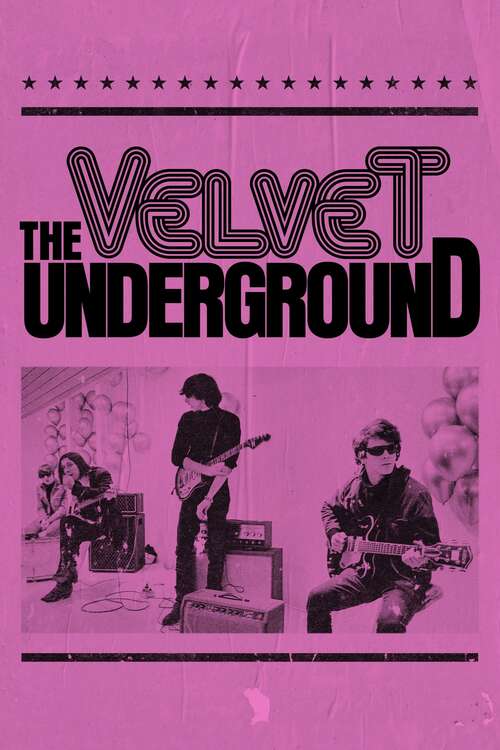
There's a lot to like here if you're already a fan — or at least, have some interest. Probably not too much if neither of those apply.
It has interviews with those who are still with us (or who were when it was made). Not just John Cale, Moe Tucker, Doug Yule, but members of Andy Warhol's Factory crew (the 'Superstars'), like Mary Woronov and Gerard Malanga.
I'd like to have heard more of the songs, especially the less well-known ones, and seen more footage of them, such as there is. It uses the documentary style that just films people speaking and edits those interviews together. That has a certain power, but I feel it might have helped to have a narrative, a voiceover elaborating on the story.
Recommended, though.
Withnail & I, 1987 - ★★★★

Long time since I saw this, so all I remembered really were the quotable bits ('We've gone on holiday by accident!')
The high dinginess and run-down state of Britain as the sixties ran down is skilfully evoked. It's very male, though. The only female character is the woman in the tearoom who refuses to serve our heroes. If that's the right word.
It's not laugh-out-loud funny, but it has aged surprisingly well.