
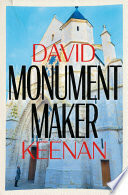
Currently reading: Monument Maker by David Keenan 📚
I’ve read a few of his before, and they’re all strange. This one may be the strangest yet, but I’m only about 40 pages into a huge book.
📚 Books 2024, 2: The Seven Moons of Maali Almeida by Shehan Karunatilaka
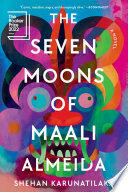
I can see why this won the Booker last year the year before last. It’s beautifully written, with a kind of light, easy style. And yet it goes to some very, very dark places.
The titular Maali is dead at the start, finds himself in the afterlife, and doesn’t know how he died. He’s given seven days — the ‘moons’ of the title — to find out, or not, before he has to decide whether or not to go into ‘The Light’.
There are ghosts, ghouls, demons, and horrors. Most of the latter two are living humans, because we’re in Sri Lanka’s civil war, and Maali was a photographer who photographed the horrors. Many of the dead he meets died in atrocities, and they’re not shy about sharing their stories.
I can highly recommend this, but not if you’ll be too disturbed by stories of atrocities. So think of this as a content warning.
📚 Books 2024, 1: This Is How You Lose the Time War by Amal El-Mohtar & Max Gladstone
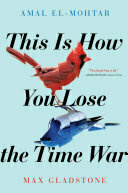
A Christmas present from my son. I know I read it before, but that was on Kindle, and he didn’t know that, and this is a nice physical book.
It’s a lovely story as well as a lovely book, about two near-immortal warriors, competing and falling in love as they range up and down the timestreams.
All that I said in 2020 still applies.
I didn’t have China Miéville co-writing a novel with Keanu Reeves on my 2024 bingo card, but here we are.
Currently reading: The Seven Moons of Maali Almeida by Shehan Karunatilaka 📚
My current book-club book. Shouldn’t be any trouble to finish it by the 18th.
This year I’m going to do my book posts Micro.blog-style, using its Bookshelves feature. We’ll see how they go.
Anatomy of a Fall, 2023 - ★★★★½
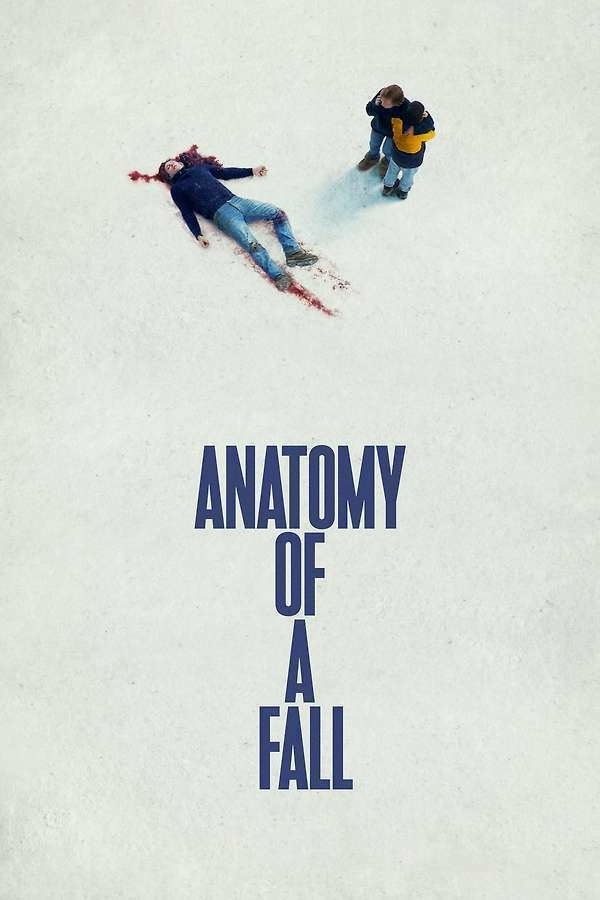
My god, but this film is good! Courtroom drama, French style, that manages to make you doubt your initial belief in the main character's innocence repeatedly, before swooping you back to her side again.
Utterly compelling. Certainly the best film I've seen this year; and while that's obviously a joke, it might remain the best for quite some time.
And unlike my other recent trip to the cinema, here everything isn't spelled out and all ambiguity removed.
Maestro, 2023 - ★★½
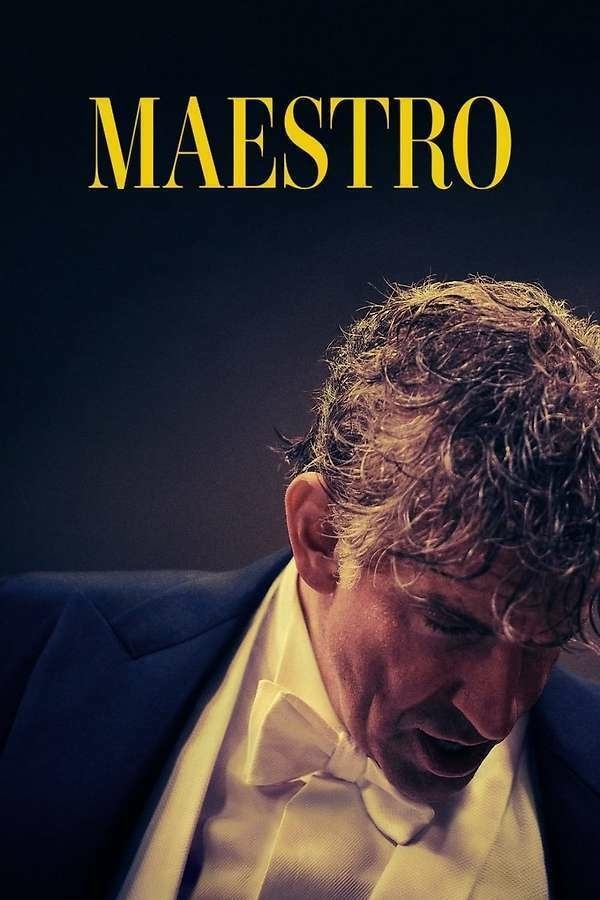
We ended last January watching a film about an imaginary conductor, namely Tár. We closed out 2023 watching this one about a real conductor and composer.
The pure fiction was much more interesting and enjoyable than the biopic.
I noticed early on that we had seen no performers; not shots of the orchestras Bernstein was conducting, or only of them taking a bow. Some of him playing the piano, certainly, but where were the others?
We did eventually see an orchestral performance, with Bradley cooper massively exaggerating a conductor's movements — though that might be an accurate reflection of Bernstein's style.
But as my beloved pointed out today, what was really missing from this film was the music. There is music in it, certainly, but it's not really _about_ the music, or Bernstein as musician, composer, conductor.
It's about his marriages and his philandering, mostly. Which is fair enough. But why, then, call it Maestro?
I read 27 books in 2023; just over one a fortnight, which seems faster than it felt at the time. And I posted 111 times, with the following monthly breakdown:
| Month | Posts |
|---|---|
| Jan | 16 |
| Feb | 11 |
| Mar | 5 |
| Apr | 10 |
| May | 6 |
| Jun | 1 |
| Jul | 7 |
| Aug | 13 |
| Sep | 12 |
| Oct | 9 |
| Nov | 9 |
| Dec | 12 |
With my yearly theme of ‘Getting Out and Connection’, I’ll try to put a few more posts out into the world in 2024.
Edinburgh by Alexander Chee (Books 2023, 27) 📚
Back in 2021, when I read Chee’s How to Write an Autobiographical Novel, I expressed an interest in this book, Edinburgh, largely because of its title. As I said then, ’the Edinburgh connection in the novel didn’t survive the writing and editing process, but he kept the title anyway.’ There is, in fact, a tangential character in this who has a loose connection to the city, but it’s not relevant.
What we have is a bildungsroman, the story of a boy becoming a man, knowing he’s gay from an early age, and going through various experiences both because of that fact and having nothing to do with it.
But about halfway through, the first-person narrative switches to a different character’s first-person narrative, which caused me some confusion. The sections are headed with the name of the narrator, but since there is only this one change, then a change back for the last quarter, it wasn’t immediately obvious what was going on.
That was OK though. What I didn’t enjoy so much was a kind of allusiveness that really became vagueness, which at times made it slightly hard to see what he was getting at. Especially in the last quarter.
And that last quarter is the most difficult and problematic part of the whole. See, early on, the first narrator is abused, along with several classmates, by a teacher. This doesn’t seem to have much effect on the narrator, though it does on some of the other victims.
But in the end the main narrator becomes an abuser himself; of the other narrator, who is linked to the whole story in a way that is, frankly, too coincidental. And it all ends in a kind of unresolved ambiguity which I found left a bad taste.
All in all, I preferred his nonfiction.