
We also finished the Christmas cake today. The true end of the season.
Performing Pages
Every month Google, or specifically the ‘Google Search Console Team’ sends me an email showing the ‘Top performing pages’ on my site. Presumably that means the ones to which they, Google, have sent the most people.
Consistently, the top one is a post from 2012, about a particular use case of Pandoc. Specifically: Tip: using Pandoc to create truly standalone HTML files.
So it’s clear that if I want more engagement here – or at least more drive-by readers – I should write more technical-support-type articles.
That’s unlikely to happen at the moment. That page was a complete mess, though. There were artifacts left over from WordPress plugins, and the whole thing was displaying at the wrong width for reasons that I don’t understand. So I’ve cleaned it up, and now at least it looks a bit more welcoming for the hundreds of visitors who come every month.
I’m not even sure what it describes is still necessary – Pandoc has had a lot of changes since then – but it’s not wrong, so oh well.
A Pasta Mystery
I’ve never heard of the pasta shape called bucatini before (though the Mac spellchecker has), but it sounds fabulous, and I want to try it now. I won’t be able to, though (even if you can get it in the UK). This article by Rachel Handler in New York magazine is great: both hilarious and fascinating by turns.
Things first began to feel off in March. While this sentiment applies to everything in the known and unknown universe, I mean it specifically in regard to America’s supply of dry, store-bought bucatini. At first, the evidence was purely anecdotal. My boyfriend and I would bravely venture to both our local Italian grocer and our local chain groceries, masked beyond recognition, searching in vain for the bucatini that, in my opinion, not to be dramatic, is the only noodle worth eating; all other dry pastas might as well be firewood. But where there had once been abundance, there was now only lack. Being educated noodle consumers, we knew that there was, more generally, a pasta shortage due to the pandemic, but we were still able to find spaghetti and penne and orecchiette — shapes which, again, insult me even in concept. The missing bucatini felt different. It was specific. Frightening. Why bucatini? Why now? Why us?
– Rachel Handler, What the Hole Is Going On? The very real, totally bizarre bucatini shortage of 2020.
I could use such short, tweet-like posts as, effectively, paragraphs on a ‘Today Page,’ as Dave Winer and some other bloggers do.
I have a sort of mental goal of increasing my post-count this year. Ideally I’d like to hit 365. That doesn’t mean posting every day, necessarily (I didn’t post yesterday); but would need me to post several times per day. Even inconsequential fripperies like this.
Blog Stats 2020
As convention dictates, a summary of 2020’s posts. 173 in total, which is up on 2019’s total of 130. No SQL needed, unlike previous years. I just have to look at the archive pages.
| Month | Posts |
|---|---|
| Jan | 18 |
| Feb | 13 |
| Mar | 14 |
| Apr | 14 |
| May | 19 |
| Jun | 15 |
| Jul | 18 |
| Aug | 18 |
| Sep | 6 |
| Oct | 9 |
| Nov | 18 |
| Dec | 11 |
2018’s post; and 2017’s
The Monsters We Deserve by Marcus Sedgwick (Books 2020, 30)
The first of my Christmas books, so I could count it as next year’s; but since I had finished it by the day after Boxing Day, it definitely belongs to this year. And it also brings me to a nice round 30 books for the year.
A writer is isolated in a lonely alpine chalet to write about a book he hates. Which very quickly turns out to be Frankenstein. He is visited by – well, that would be telling, but just let’s say that the novel he’s writing about and its creator are very significant.
It’s written – at least at first – as if it was the writer writing to his publisher, though that conceit soon disappears. There are various details around the way it’s printed, that look as if they should be significant, but they aren’t really.
It’s good. Check it out.
Endings
Well, this year of infamy is finally lurching towards its end. I don’t think too many of us will be sad to see the back of 2020.
With it, though, we have to also say a final goodbye to Britain’s membership of the European Union. I don’t think too many of us will be happy about that. Even people who are pleased about it now will realise over time that leaving is a huge mistake.
At least with the exit agreement in place, we shouldn’t see the immediate shortages and queues at the ports that we feared. That agreement is problematic, though.
To get an example of its dangers, I refer you to David Allen Green’s Law and Policy Blog. Yesterday’s post is entitled ‘The Bill implementing the Trade and Cooperation Agreement is an exercise in the Government taking power from Parliament,’ and in it he says:
The draft bill is complex and deals with several specific technical issues, such as criminal records, security, non-food product safety, tax and haulage, as well as general implementation provisions.
Each of these specific technical issues would warrant a bill, taking months to go through the normal parliamentary process.
But instead they will be whizzed and banged through in a single day, with no real scrutiny, as the attention of parliamentarians will (understandably) be focused on the general implementation provisions, which are in Part 3 of the draft bill.
[…]
This provision will empower ministers (or the devolved authorities, where applicable) to make regulations with the same effect as if those regulations were themselves acts of parliament.
In other words: they can amend laws and repeal (or abolish) laws, with only nominal parliamentary involvement.
There are some exceptions (under clause 31(4)), but even with those exceptions, this is an extraordinarily wide power for the executive to legislate at will.
These clauses are called ‘Henry VIII’ clauses and they are as notorious among lawyers as that king is notorious in history.
Again, this means that parliament (and presumably the devolved assemblies, where applicable) will be bypassed, and what is agreed between Whitehall and Brussels will be imposed without any further parliamentary scrutiny.
– David Allen Green, The Bill implementing the Trade and Cooperation Agreement is an exercise in the Government taking power from Parliament
The whole piece is worth reading (and note the Hitchhiker’s Guide to the Galaxy references).
Take back control, right enough: take it back from the elected representatives of the people, and give it to the executive.
2020 made 2016 look like 2012. 2021 offers hope to the world as the Covid vaccines roll out, and hope for America as Trump is rolled out of the White House. But things still look decidedly dodgy here in the UK.
Xstabeth by David Keenan (Books 2020, 29)
Following on from number 27, then, we have David Keenan’s latest novel. Again we’re in a kind of magic-realist setting, without any obvious magic. In St Petersburg a young woman lives with her father, who is a failed or fading musician. The daughter – who is the viewpoint character – starts a relationship with her father’s friend, and gets pregnant. She keeps all of this from her father.
Her father, meanwhile, puts on a show at which he performs some seemingly-otherworldly music. He starts to believe that it was actually created by some sort of mystical entity called Xstabeth.
For reasons that escape me at the moment they go to St Andrews,1 where they get involved with a professional golfer. The ’tenuous, ambiguous, confusing event’ that I referred to in the earlier note happens from this side too, but you’d only notice it if you’d read The Towers The Fields The Transmitters.
The novel is presented as if it were an academic work about a novel called Xstabeth, by someone called ‘David Keenan,’ who killed himself by jumping from a tower in St Andrews. So there are cod-academic sections or extracts between the chapters.
It’s all very meta, and I enjoyed it, but I’m not sure I totally understood it. The strangest thing about it, in some ways, is the use of punctuation. Almost the only punctuation used is the full stop. But that doesn’t just mean he’s avoided using commas and semicolons, and constructed appropriately short sentences. It reads as if he wrote it with conventional punctuation around dialogue and so on, and then replaced every other mark with the full stop.
For example, consider this:
This is singular. He said. This is music that cannot be repeated. This is music that can never be toured. This is music that can never be applauded. I pointed out to him that there was applause on the record. Muted Applause. Awkward applause. Uncomprehending applause. But still. Applause. What is the sound of one audience member clapping. I asked him. He laughed. Yes. He said. Yes. Yes. There is no mechanic in the world for this music. He said.
A more conventional way to punctuate that and lay it out, might be:
‘This is singular,’ he said. ‘This is music that cannot be repeated; this is music that can never be toured; this is music that can never be applauded.’
I pointed out to him that there was applause on the record. Muted applause; awkward applause; uncomprehending applause; but still: applause.
‘What is the sound of one audience member clapping?’ I asked him.
He laughed. ‘Yes,’ he said, ‘yes, yes. There is no mechanic in the world for this music,’ he said.
There are, of course, other ways you could present it. As an experimental way of presenting text, it’s interesting enough. I found it intruded, in that I constantly noticed it; but not so much as to be annoying. Though there were places where it was slightly confusing. I paid particular attention to it because we recently discussed ways to present dialogue on my course.
-
Still needs an apostrophe. ↩︎
Honestly, it’s great: I love the fact that I can stream all the albums in the world for one flat monthly fee.
I just wish that so many of them didn’t end their titles with ‘(Expanded Edition)’.
Or at least that the ‘Original Edition’ was there too.
The Hate U Give by Angie Thomas (Books 2020, 28)
Read this for the young adult (YA) section of the Genre module on my course. It’s a powerful story inspired by the Black Lives Matter movement.
In an unnamed US city, a teenaged girl is the only witness to her friend being murdered by a police officer. She has to find her way through the complexities that follow, including family, school, friendships, the law, and the streets of the neighbourhood she grew up in.
It’s a tough read at times, as is it should be. But it’s also very funny in places. Well worth checking out.
The soundtrack for today starts with Earthquake Weather. How can Joe Strummer have been dead for eighteen years already?
I know, that’s just the way time works. The music lives on.
Rees-Mogg and the New Depths
Just when you think that this Tory government couldn’t possibly sink any lower, Jacob Rees-Mogg, the leader of the Commons, says this:
I think it is a real scandal that Unicef should be playing politics in this way when it is meant to be looking after people in the poorest, the most deprived, countries of the world where people are starving, where there are famines and where there are civil wars, and they make cheap political points of this kind, giving, I think, 25,000 to one council. It is a political stunt of the lowest order.
Unicef should be ashamed of itself.
– The Guardian’s Politics Live, Rees-Mogg accuses Unicef of ‘political stunt of lowest order’ after it funds food aid in UK
This in response the a news report that Unicef, the UN’s relief fund, is contributing money to help feed kids in Britain for the first time ever.
And the top-hatted tosspot thinks Unicef should be ashamed. We should all be ashamed; but the government most of all.
The Towers The Fields The Transmitters by David Keenan (Books 2020, 27)
Strange one, this. I read Keenan’s This is Memorial Device a couple of years ago, so when I saw a new one by him listed on my local bookshop’s ‘forthcoming’ page, I had a look.
That book was Xstabeth, and more on it in a few posts’ time. It hadn’t yet been released at the time, but there was a special offer from the publishers: upload proof that you had preordered it (such as the receipt from your local bookshop) and you’d get a free novella-length ebook prequel: The Towers The Fields The Transmitters.1
So I did all that, and here we are.
I’ll note right away that, having read both, they seem to be connected only by location and one tenuous, ambiguous, confusing event.
In fact those terms apply throughout this book. It’s kind of a magical realism piece, set mostly in St Andrews.2 A businessman visits the town to audit the books of a military facility, and starts trying to find his missing daughter. Why does he think she might be in St Andrews? That is never explained. Nor does it need to be.
Time goes weird, with second-world-war bombers appearing in the skies. Or on the phone, at least.
The more I try to write about this, the more it feels like a hallucination I had a few weeks ago. Very strange. Worth reading.
Yesterday I tried removing my taped-on mask slowly, and it was actually much better. So I rescind my advice from the day before about removing it quickly.
Stop Your Glasses Steaming Up by Sticking the Top of Your Mask to Your Face Using Micropore Tape
The problem
If, like all sensible people, you wear a mask over your mouth and nose when you go out these days; and if, like me and millions of others, you wear glasses; then you will have experienced your breath causing your glasses to steam up.
The cause is a fundamental flaw in mask design: the mask fabric makes a straight line from our cheeks to the bridge of our noses, leaving a gap between face and mask seam. Most of our out-breaths are directed that way, just by taking the path of least resistance.
Some masks have a wire insert that lets you mould the top section around your nose. I find that improves things, but is still imperfect. There are always gaps.
The Bigger Problem
This means that the masks are not as effective as they should be for their primary purpose. All that warm, damp air that’s condensing on our glasses is also the air that might be carrying virus particles.
So while this solution helps with the steamed-up glasses problem, it also helps to make masks more effective, by ensuring that more of our potentially-poisonous breath goes through the fabric.
The Solution
It’s quite simple: apply a strip of micropore tape to the section of the mask that goes over the bridge of your nose, and seal it down well.
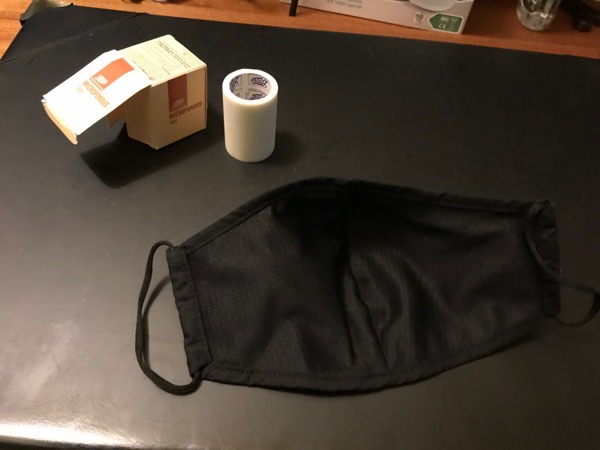
Micropore tape is normally used for fixing dressings on wounds, so it’s designed to stick to skin and come off with minimal fuss (though see below).
The roll we had when I thought of this is quite wide, so I’ve been folding a piece over and attaching it to the inside of the mask (at @FranChats’s suggestion).
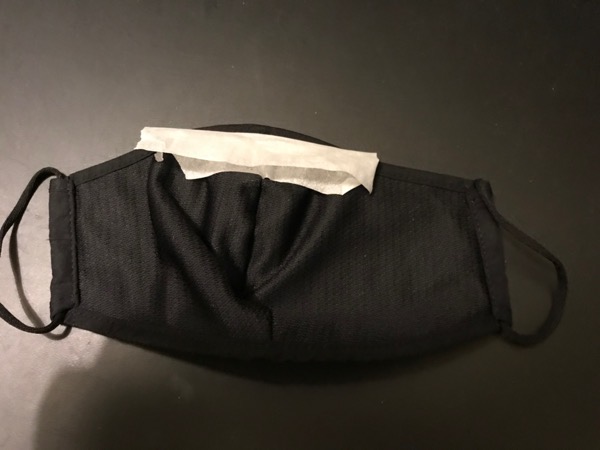
As you can see, it’s not attached very tidily, but we’re not in this for the aesthetics.

And it’s not actually visible when the mask is on.
The New Problems: Removal, and Sensitivity
Taking the taped mask off is the worst part, in my experience. I’ve been doing it quickly: take off my glasses (otherwise they might go flying across the room); unhook the ear loops and take a firm grip of them; close my eyes; then tug sharply forward.1
It can make your eyes water, but honestly, for clear vision outside on these cold days, it’s worth it.
Removing it slowly might be better for some people. And the whole thing will not be for some. If you have very sensitive skin, or get a reaction to the adhesive, then this won’t be for you. But if you can take it, I highly recommend it.
Lastly, my pictures show a reusable mask, but it works for disposables too.
-
Though see my later post. I think I’ll be doing it slowly from now on. ↩︎
How to Make Sure You See My Posts
If you’re reading this, it may not apply to you, but I want to let you know that there are a number of ways to make sure that you see all of my posts. Should you wish to.
Now With Added Email
If you follow that link on the left labelled ‘Subscribe,’ you’ll see all the ways.
RSS, Twitter, Micro.blog, WordPress.com; no surprises there.
But if you prefer to use the oldest protocol of all (at least for these purposes), there’s a form on that page that will let you sign up to get the posts by email.
So now you never have to miss a post again.