
Just found a typo in my diss: ‘Jeff the sandman,’ instead of soundman. Should probably be two words, ‘sound man,’ but anyway, an unexpected @NeilHimself-esque touch.
One Week Away
My dissertation is due in just under a week. I’m seeking an extension, because I’ve been a bit poorly and have lost a lot of work time over the last week, but I still hope to get it in on time.
But that will mean my course will be over. Which is a little bit saddening. I’ve enjoyed being a student again, even though this academic year’s particular situation has meant that the experience has been distinctly unlike a classic student one. Even, I’m sure, for Birkbeck, ‘London’s evening university.’
I have, for example, met none of my classmates in person. I’ve met exactly one member of staff, and that in the park in Gordon Square. I’ve never been in the department’s building. I’ve been into any Birkbeck building – the library – I think three times, maybe four.
Online classes have been fine, though. I wonder if creative writing, in its common workshopping format, works especially well over Teams or Zoom. Everyone takes turns to comment on the piece that’s being discussed, and there’s much less scope for interruptions, compared to in person. Of course the downside of that is that there’s less scope for conversation, for organic discussion. So we probably lost out in some ways, too.
Less, though, than students on other courses, and especially first year undergraduates. Like my daughter, who has done a year of uni and met practically no one on her course. It’s a strange state of affairs, to be sure.
But we move on. This novel extract isn’t going to dissert itself.
Rainbows End by Vernor Vinge (Books 2021, 17)
The absence of an apostrophe in the title has disturbed me slightly since I heard of this book. I think I concluded that it was meant as a verbal statement: rainbows do end, after all. The fact that the last chapter is entitled, ‘The Missing Apostrophe’ comforts me.
The other Vinge books that I’ve read (which would appear from that to only be one, but that is misleading) are galaxy-spanning space operas. This, in contrast, is very compact in scale, being set almost entirely in San Diego, and on the net. It’s a near-future thriller about medical and technological advances and how things might be for someone who was nearly dead from Alzheimer’s and then was brought back.
It’s pretty good, but 2025, the year in which it is set, feels pretty close now. I guess it didn’t in 2006.
Today is Irony Day: Wetherspoon’s short on some beers as Brexit affects deliveries.
They blame ’lack of lorry drivers and strike action.’ Hadn’t heard about a strike; does it exist? And more importantly, what on Earth could have caused a lack of drivers???
I sent my CV to a recruiter today, for the first time in a long time. Dissertation due in less than a fortnight, so I have to start thinking about what’s next.
In an ideal world I’d be able to make a living from writing. This was a programming-type recruiter, though.
Big Planet by Jack Vance (Books 2021, 16)
I actually read this before the previous one, but forget to write about it. Perhaps that’s because I didn’t enjoy it very much.
Jack Vance is considered one of the greats of SF, and I realised recently that I hadn’t read anything by him. And I had this big volume that Gollancz gave away at a convention some time, containing this and two other books (another novel and a collection of short stories). A sort of literary compilation album.
But not a Greatest Hits — or if it is, then things are pretty bad.
The main problem is that it’s dated. Usually we can work around that sort of thing, and I did — look at me, all finished with it — but the main thing here is that it’s just badly written. Cardboard characters, dodgy sexual politics, and a plot that, while interesting enough to get me through it, is far too easily resolved.
And there’s the background of an Earth empire or federation or similar, that we see essentially notthing of. Instead the action is all confined to the eponymous planet. It ‘revolutionised the planetary romance,’ according to the blurb. And, indeed it was important to the form according to the linked SF Encyclopedia entry.
So much for that. All I can say is, it didn’t do a lot for me.
Whit by Iain Banks (Books 2021, 15)
The human memory is an amazing thing. In this case, it’s amazing what it’s possible not to remember.
To wit: I remembered almost completely nothing about this book. That the main character was part of an odd religious community based near Stirling in Scotland; and that she had to make a trip to London by slightly unusual means to track down a musical and possibly apostate cousin: that’s as far as my memory went.
It came out in 1995, so twenty-six years have passed since I first read it. I would have said that I had reread it once, which you would hope might lock things down a bit in the brain. But on the plus side, it meant it was almost like reading a new Iain Banks book, so in that way the forgetting was good.
As you’d expect, a great deal more happens than what I remembered. It’s another family drama, in the vein of The Crow Road1 and The Steep Approach to Garbadale. Also has a very endearing main character, as well as religion that doesn’t sound too bad in its beliefs, apart from its rejection of most technology.
-
Which I note that I’ve never written about here, except indirectly. Is it time to rerereread that, do you think? ↩︎
MA Latest
I realised the other day that it’s a year ago that I was applying for creative writing MAs, before being accepted on and choosing the one at Birkbeck.
Well that went fast.
2021 feels like it’s being disappearing even faster than 2020 did, which is strange. Or maybe not. The pandemic is far from over, of course, many things are still up in the air, and it could all change again in an instant.
But I’ve been lax in reporting on what’s been going on with the course . The summer term was all an optional lecture series, which largely consisted of members of staff interviewing writers, along with one or two pieces about the craft of writing. One on the structure of the novel, and one a session with some agents.
That last one probably had the most practical value – at least potentially – but they were all interesting.
Other than that, My dissertation is due in a month. Actually now just under four weeks. It consists of 15,000 words of creative writing (plus or minus 10%, so up to 16,500), plus a 3000-word preface (also plus or minus 10%). I have 23,000 words, of which I can’t use the first five or six thousand, because I already submitted them for an earlier assessment. So there’s plenty to work with.
It feels a little odd to have paused the forward flow – I intend this to be a novel, after all – to work on editing what I have so far. But it ought to be worthwhile for the novel, as well as being necessary for my dissertation. This period of working over what I’ve already done should give me a firmer base on which to build the rest.
I think I miss classes. I only had two a week for the first two terms, and a slightly more erratic schedule averaging to one a week for the third, but they provided structure, as well as a feeling of connection with others on the course. So I’m looking forward to an informal workshop session some of us have arranged for this week.
But beyond that, the future. What’s next?
London Centric: Tales of Future London, Edited by Ian Whates (Books 2021, 14)
Great collection of stories set in and around London. Or various Londons, depending on how you look at it.
Standouts for me were the opening story, ‘Skin,’ by Neal Asher, and ‘War Crimes’ by MR Carey, but there’s a lot to enjoy here, and not one bad one.
It’s good to know the science fiction short story is in a good state, despite what I said about it… err, seven years ago.
The Exes by Pagan Kennedy (Books 2021, 13)
Another one suggested by my supervisor. It’s about a band, and the novel I’m working on involves a couple of bands. And it’s also a multiple viewpoint third-person narrative, as is mine.
Like the last such, it handles the multiple viewpoints in quite an extreme way. There are four band members, and a quarter of the book is told from the point of view of each. Four chapters, no returning once one PoV is finished with.
The title is the name of the band, and their schtick is that they are all exes of someone else in the band (in practice, it’s two former couples, but there’s obviously a certain amount of will they/won’t they about any other possible hookings up).
So really it’s about the relationships, and how each person handles the pressure-cooker of being in a band together, touring, all that. Along with a fair chunk of backstory for each.
It’s set in Boston (and a few other places) in the early to mid nineties. The ending is – open, let’s say, but not in annoying way. In fact, it’s quite satisfying, though I could happily have read more.
My parents taught me to always give to the RNLI when they’re collecting, because of how important and dangerous the sea is. Lifeboat crews deserve all our support.
Some idiots don’t think so. Instead they want our seaborne heroes to let people drown if they don’t have the right papers.
Fuck that shit, and fuck those people.

Who's Next?
Sorry, that’s, like, the most obvious title in known space. Jodie and Chris are leaving Doctor Who after the next series and specials. Late 2022, that is.
That BBC News report is almost comically self-flagellatory. After quoting Jodie Whittaker’s hugely positive statements about the show, they say this:
While many have praised Whittaker’s casting, some fans and critics have criticised the show’s recent narrative direction.
The Telegraph described recent episodes as “flat, worthy and woke” despite Whittaker’s talent as an actress, while The Sun reported viewers were left furious by the show’s “unbearable political correctness”.
– Uncredited BBC reporter, Doctor Who: Jodie Whittaker and Chris Chibnall to leave in 2022
If those publications are making those criticisms, I’d say that’s a big win. Stop beating yourself up, the BBC. The programme is and remains a success, the jewel in the BBC’s crown.
Significantly further down the report they say:
Episodes such as Rosa, Demons of the Punjab and Spyfall thrilled audiences, and netted the show two Bafta Must See Moment nominations, along with multiple National Television Award, Bafta Cymru, TV Choice and Critics Choice nominations.
In 2020, Whittaker was voted second most popular Doctor of all-time in a poll of 50,000 fans for the Radio Times, losing out to David Tennant.
– As before, Doctor Who: Jodie Whittaker and Chris Chibnall to leave in 2022
So there you go. Now: who’s going to the the next Doctor? And – arguably more importantly – who’s going to be the next head writer?
Or will they just put the show on ice for a few years? I read a piece recently that suggested that’s what it needs to revitalise itself, citing the gap from 1989 to 2005 as the model.
I hope they don’t do that. In fact, if it needs revitalisation at all, then last season’s big revelations about the Doctor’s origins are just what they need for that. You could, for example, have a season or two of Jo Martin’s Doctor. She’d be great, though such a move would confuse people, since it would be in the past of the Doctor we know.
We can only look forward to finding out.
Dragonfly, or Not?
In Dragonflies and The Twisties, Austin Kleon writes about dragonflies.1 He links to a Washington Post article from 1989 by Henry Mitchell. It’s about gardening, and it contains the wonderful line (of the insects in question), ‘They are nothing but good and fair, a sufficient reason for summer to exist.’
Coincidentally, I was in the sitting room with the window open the other day, and one flew in. I’ve only seen them very occasionally in the wild, skimming along above a river or pond. I’ve always found them slightly disturbing, because they’re so big for an insect. It’s an echo of the utter revulsion I remember feeling in a biology lab back in my schooldays, where there were stick insects. Some people were happy to take them out and hold them, but I could barely stay in the room.
It’s borderline phobic, I realise: stick insects don’t even do anything, they just sit there being camouflaged and inoffensive. But there’s nothing we can do about that kind of gut reaction.
Except maybe allow time to pass. Back in the sitting room with the visiting dragonfly, I was surprised, but felt more fascination than revulsion. I closed the door so it wouldn’t go further into the house, opened the window wide, and waited to see if it would go out. There wasn’t much else I could do: even if it settled, it was much too big to catch under a glass to release outside, as I would a spider.
The pattern of its flight was strange and erratic-seeming. Very different from the flies, wasps, and moths that much more commonly come into houses. Something to do with those double wings and that long tail, maybe. It pootled around, approached the window a couple of times, without going for the open part, but didn’t bang itself against the glass as the smaller visitors do.
Once it rested up on the plaster moulding near the ceiling.
Eventually it flew towards the window again, found the opening, and was gone. It’s a short walk, and a shorter flight, down to the River Lea, its likely habitat round these parts. But I wonder what brought it all the way up here.
And now looking at the Wikipedia article, I wonder if it was actually a damselfly:
Dragonflies can be mistaken for the related group, damselflies (Zygoptera), which are similar in structure, though usually lighter in build; however, the wings of most dragonflies are held flat and away from the body, while damselflies hold their wings folded at rest, along or above the abdomen. Dragonflies are agile fliers, while damselflies have a weaker, fluttery flight.
I’m not sure how it held its wings when it rested, but that ‘weaker, fluttery flight’ does sound more like my interesting summer visitor.
-
And also about the incredible Simone Biles. ↩︎
Passport to Pimlico, 1949 - ★★★★
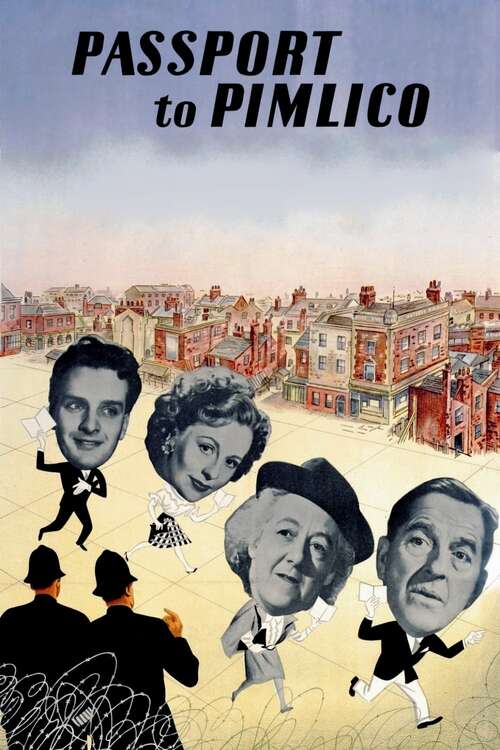
I think I probably saw this classic Ealing comedy, or part of it, when I was a kid, but it was good to watch it properly on a rainy Sunday afternoon.
Set a few years after the Second World War, it tells the story of the discovery of a hoard of treasure and a royal proclamation that makes Pimlico in London part of the ancient Duchy of Burgundy. The locals promptly claim the treasure and proclaim their independence from the UK.
Problems ensue for the Home Office -- or does the Foreign Office have jurisdiction?
The ending is a little weak, but it's a lot of fun getting there.
Multiple Points
Just last month I wrote Single Points, about the Fastly CDN outage. This morning many, many sites were down or inaccessible because of an outage at Akamai. A content delivery network again, though they’re saying the outage is caused by ’edge DNS.’ I’m familiar with DNS, but not the ’edge’ variant. In fact, I realise it’s capitalised and is the name of an Akamai product or service.
More evidence that the increasing centralisation of internet services is a problem. On the plus side, it was resolved quickly. When a service provider has the kind of major clients we’re talking about here, then that company is going to have to be able to respond quickly and get things back up. If a random small or midlevel company ran all its own server hardware and software, an outage would only inconvenience that company’s customers. But the company would need to have the staff available to sort the problems out. That would be a large and arguably unnecessary overhead.
So I understand the desire to offload responsibilities to a service provider, and the economies of scale that a company specialising in running network services can bring. But I fear it’s only a matter of time before one of these events results in serious damage or even loss of life.
Not that I’m claiming to know what the answer is.
Diary of a Film by Niven Govinden (Books 2021, 12)
A famous film director arrives in ’the Italian city of B’ to attend a festival and premiere his new film. He meets a woman who shows him a graffiti mural that was painted by her dead boyfriend.
The whole thing takes place over two or three days, and each chapter is a single paragraph. The latter is kind of annoying, because it makes it hard to find a good place to stop reading. Also all the dialogue is integrated into the paragraphs without speech marks. This kind of different way of representing dialogue is becoming increasingly common, it seems to me.
The story’s good, though I found the ending a little weak. And slightly reminiscent of the ending of The Magus, strangely. That same sense of slightly-incomplete explanation.
Black Widow, 2021 - ★★★★

I was last in a cinema in February 2020, to see Parasite. Today I went to the same cinema to see Black Widow. It was great and strange and moving to be back in a cinema at all, and when the Marvel ident started playing at the start... well, it was pretty special.
And the film itself is great. I'm not going to say too much about it, obviously, but it's a fitting debut for Black Widow in a solo film, and farewell for Scarlett Johansson playing the character.
At the screening I went to, at two o'clock on a Friday afternoon, there were my daughter and me in row H; one guy sitting two or three rows in front and far off to one side; and somebody sitting right up the back and also far off. So it wasn't like we were crowded in with people like in the old days. That was quite comforting, but I can't imagine the film is grossing the way Marvel ones have tended to. Still, everyone knows why that is.
Summerwater by Sarah Moss (Books 2021, 11)
My other dissertation supervisor, Julia Bell, suggested that I read this. It’s a multiple-viewpoint work, which is something I’m doing. This one takes it to extremes, though. Each chapter is from the point of view of a different character, and we never go back to any of them.
They’re all members of families who are staying at holiday park of log cabins deep in the Highlands of Scotland, one week when the rain never stops.
It does an excellent job of showing us the inner lives of the different people, as well as the minutiae of what goes on at the park in such difficult circumstances (no internet, miles from anywhere, and constant rain).
And the ending is – well, it’s something else, I’ll say that.