
Longform
Understanding a Misunderstanding
Spotify has always behaved weirdly regarding how you queue tracks up. Today I think I realised why.
They think “Queue this track up” means “Cue this track up”. They’re thinking like DJs, but they are confused by homophones.
I’m thinking like a programmer, I admit: queues are first-in-first-out; but more importantly, like an ordinary person: you join a queue at the end, not just behind the person at the front.
See this discussion on their suggestions board which explains the weirdness, and is where (as I was adding a comment) I suddenly understood their thinking. Also definition 2 of “cue” is the appropriate one.
Edited: Queues are of course first-in-first-out, not last-in-first-out, as I wrote. That would be a stack, in programming terms. Whoops!

Pulp Magazine Covers for All
The [Pulp-O-Mizer](http://thrilling-tales.webomator.com/derange-o-lab/pulp-o-mizer/pulp-o-mizer.html) is a fun thing that lets you generate pulp-magazine-cover-style images, with your own text and good range of images, backgrounds, colours, etc. You can download web-size versions of your creations, or get them printed on cards, notebooks, mugs, etc, at [Zazzle](http://www.zazzle.com/); though I haven’t managed to work out how to get it to use the UK version of the Zazzle site while still keeping your generated image.
Here’s one that I made using the title of a story of mine. It remains unpublished so far, but it was the short story that was the seed for the [novel I finished in November](http://devilgate.org/blog/2012/12/02/november-spawned-some-words-but-not-that-many/).

Day Trip
We had a wee day trip to Cambridge yesterday (Monday). Lovely city. I took some photographs. They're so small and unlinked because, I think, I'm experimenting with a plugin for Lightroom that uploads them directly to the blog. But I have a few wrinkles to iron out, I think. There are bigger versions of them [at my Flickr account](http://www.flickr.com/photos/devilgate/), if you're interested.
First, some punters punting on the Cam:


Then the famous King’s College Chapel. More of a cathedral, really:

This wee guy looks decidedly unhappy:

There’s a pair of war memorials in a side chapel. A famous name at position 2 of the WWI one:

There’s plenty of stained glass, of course, but in another side chapel we see this interesting creature:

Then on to Trinity College Chapel, where Isaac Newton stands in marble:

Here’s a closeup of Newton. I can’t work out what he’s holding:

And above him there’s this rather attractive chandelier and dramatic ceiling:

Strange Blog Behaviour
For some reason WordPress decided to repost the two posts that currently appear immediately below this one. I have no idea why. They have in common that they are both of the “Link” format (“Format” here is a WordPress concept denoting types of post).
The mildly annoying thing is that I haven’t posted here yet this year, and now I seem to have started the year with two reposts. I could, of course, delete them, but then the above paragraph would be wrong.
Anyway, this is the true first post of the year, even if it was triggered by an aberration.
Hello. Happy New Year.
Instagram and Terms
I never really got Instagram. I mean, I got the app, I signed up, and I posted a few photos. But I never totally got what it was for. I mean, social photos? OK, I followed a few people I knew on Twitter, but it never really amounted to much. And you couldn't even see your pictures on the web at first. The filters were interesting, but only up to a point, and they got worse.
But somehow I could never totally see the point. Flickr I understood: it’s a site to store your photos. If you don’t have, or don’t want the bother of managing, your own web space, you can put your pictures there and show them to other people. And it’s got the social thing going on, too, with the ability to follow people and all that. It feels a bit bolted on, but it does no harm. And when I discover a site like 500px, as I did a few weeks ago, well, that’s obvious: a place to store your pictures and to find other people’s. Not for nothing is their tag line, “The best photos on the web” (or it was: today it says, “The world’s best photo sharing”, which is similar, but different). I just wish they’d learn how to keep me signed in.
But Instagram didn’t really grab me. And today they nearly ejected me.
Oddly for a net-based thing, I heard about the new terms of service on the radio. The story was that the terms were going to allow them to sell their users' pictures for advertising, without paying, asking, or even telling the users.
I tweeted:
Did I just hear on the radio that Instagram is committing suicide?— Martin McCallion (@devilgate) December 18, 2012
It turns out to be not as bad as we thought, at least according to this post from Instagram. Though I only found that because I clicked the "I'd like to delete my account" link. On the confirmation page there was a link to that post. It turns out there's an Instagram blog, and both the terms of service change and this update were posted there. But who knew about that?
So for now I haven’t deleted my account, and we’ll see how it goes.
I found out about the change from the radio, and the correction by requesting a deletion; my inbox remains unsullied. How about a wee email, Instagram? You’ve got my address.
Edited to add: According to this post, the new terms are actually better than the old ones.
November spawned some words (but not that many)
I'm not very good at this NaNoWriMo thing, it turns out (again). This year I declared myself a NaNo Rebel (basically anyone who aims to write 50,000 words, but not of a brand-new novel). I had originally hoped to finish my previous novel before November started, and leave November clear for taking a big run at the new one, the idea for which came knocking when I was about three-quarters of the way through the then-current one. But as it turned out I didn't manage to finish it until a few days into November. So I decided just to count the words of original fiction I wrote in November.
Which proved to be just as well, because after just a couple of days on the new novel, I was cycling home from work one day when a short story deposited itself in my head, unbidden, but complete. I took a few days off from the novel to work on that, thus further ensuring my rebellious state.
As an experiment for my own interest, I also tried to keep a note of how many words I wrote for other things, both at home and at work; just to get an idea of how many words I write normally. I kept that all in a Google Docs spreadsheet, so I could get to it wherever I was. I’m sure I wasn’t complete in recording everything, though.
In the end I wrote 16,600 words of fiction;1 so comparable with last year. And oh, dear: reading over those old posts to get links makes me realise that this is the third NaNo during which I’ve been working on Accidental Upgrade.
But having said that, the thing that I’m underplaying in all this is that: I. Finished. My. Novel. 89,000 words of first draft, done and… well, left quite dusty, truth be told.
And a new short story drafted, and another novel reasonably well under way. I’m feeling quite positive about it all.
-
And around 9000 of other stuff. ↩︎
Warren Ellis on Writing Dialogue
When you have a character talking, have two things you know about their lives in your head as you let them talk. Two things that make them what they are. What was their childhood like? What was their first job? Do they spend a lot of time alone? Are they guarded around people? Because dialogue is about moving information around and expressing character. What you know about them affects the way they talk. Take a book you like — or, hell, even one you don’t — and select a passage of dialogue, and see what you can learn about those characters from the way they speak. (And, on top of that, see if the way they speak changes during the course of the book.)
Via Warren Ellis.
New Camera; Also Reviewing Purchases
I finally have a dSLR. No longer do I have to hold my camera up in front of me in that quite silly-looking way; once again I can look through a viewfinder. Hurrah!
I say “once again” because I used to have — well, still do have, but almost never use — a film SLR, namely an Olympus OM-1.
With the new one I’ve gone over to Canon, though. It’s an EOS 600D; which rather oddly is known in America as the Rebel T3i and in Japan as the Kiss X5
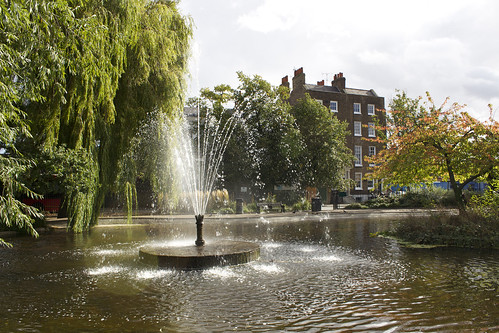
Here’s a picture of Clapton Pond to show you what it can do. Click through for a better view on Flickr.
I bought it online for full £200 less than I’d’ve had to pay at Jessops; and by going to a site called DigitalRev I saved about £100 over Amazon’s prices. DigitalRev’s service was incredibly good: my camera arrived in London from Hong Kong in two days. It took a few more days for DHL to get it to me, but that’s not DigitalRev’s fault. Really astonishingly fast service, and for the cheapest price I could find anywhere.
The only slightly annoying thing is that I clicked a link in their email asking for comments (essentially to say the above); it took me to a site called Reseller Ratings, where I filled in a few boxes, and then hit “Submit”… whereupon it wanted me to create a profile before I could submit the review. And I just couldn’t face it. I’ll almost certainly never go to that site again, so even though it’s only a name and email (and password) I just thought, “No. I’d rather put a good review up on my own site.”
So think on that, people running review sites.
Generation: Inspired
So, it's all finally over, and we go back to normal. Or perhaps not. The slogan of London 2012 was "Inspire a Generation", and I think that has happened.
But the question is, what generation?
The tacit assumption was always that the slogan applied to the next generation: to teenagers and younger kids. Get them up off their arses, it implied, and away from their consoles, and down to their local sports hall, playing field, or pool.
Whether and to what extent that has worked will take a long time to see. But there’s another generation that is already visibly inspired, to my admittedly limited view.
Mine.
Where by “mine” I sort of mean “everyone who’s not still a child.” Because what I’m seeing as I cycle to and from work these days is that the streets are packed with cyclists. And people out running, too; there are definitely more than usual. But it’s us London cyclists who are really showing up.
I personally have taken public transport to work only once since before the Olympics started,1 and I’ve been pushing myself to get that bit faster on my bike rides.
I’ve been thinking of it as something like, “Hoy! It’s the Pendleton-Trott-Kenny-Wiggins effect.” But that’s a bit unwieldy, and misses some names out.
It is clear to me, though, that the “generation” that is in their twenties, thirties and yes, forties – and probably older – are out there in bigger numbers than ever before.
We’ll see how it holds up as autumn and winter come in, of course. But vastly increased cycling in London? That would really be a worthwhile legacy.
Anyway, here’s my Flickr set from our second event at the Olympics, namely hockey. Click through to see the pictures bigger and with captions.


-
Admittedly I was on holiday for around three weeks of that time. ↩︎
Olympics: fencing and more Park views


A Flickr set from our first Olympic event: fencing at ExCeL. We went via Stratford, so we stopped off at the Westfield shopping centre on the way, to look at the view of the Park.
Olympics: some photos from the Park


This is a Flickr set of some sights around the Olympic Park the first day we were there (which was just a Park visit; no events).
(I lied about not posting photos, by the way.)
Olympian Achievements
Initial scepticism
Back in 2004, 2005 or so, when London was bidding to host the Olympics, I was against it. My concerns were the cost, the crowding, and the general disruption of it all. I was, I admit, cynical. I recall being annoyed by the fact that the people running the bid published a number to which you could text “yes”, to say you supported the bid; but there was no option to text “no” to say you opposed it.
Looking back to what I wrote at the time, I see that my biggest concern was the effect on the Lower Lee Valley. It turned out that the removal of wilderness didn’t stretch as far as my fears suggested; and of course much of the land that has been used was polluted, abandoned, brownfield industrial sites. Bob Stanley of St Etienne (the band) has an interesting piece in The Guardian about that.
Coming round
But then London won the bid, and I though, “OK, fine, it’ll be interesting at least.” I had enjoyed watching the previous ones, and there was the regeneration for East London that looked promising. And the fact that it would just be down the road for me added to the interest. After all, that would make it easier to get tickets, right? Obviously there would specific tickets made available to to locals.
Hindsight even makes me wonder whether the events of the very next day didn’t make me more supportive: blitz spirit, don’t let the bastards grind you down, “soft power”, and all that.
The intervening years
Worries
In the years since then I’ve gone through various thoughts about the whole thing. Obviously there were the concerns about how long we would be paying for it all. And more recently there were the worries about the security preparations and the expected madness of the precautions. Of course more recently we’ve had the G4S fiasco, and the drafting in of extra soldiers.
More bizarrely we’ve seen the growth of the Olympic “brand police”, the forbidding of certain words and combinations of words (including, ridiculously, things like “summer”, “bronze”, and “2012”).
Cycle-friendly or not?
But closer to home one of the things that has annoyed me is the way they’ve treated our towpath.
The main stadium sits between two branches of the River Lee (or Lea): the river itself, and the Lee Navigation or Cut, which is essentially a canal constructed as a tributary1 of the main river. The towpath of the Navigation is a popular cycling and walking route for us local types. As we watched the construction site form and the massive buildings grow (and in my case moaned about the ugly fencing round it), we were able to keep a close eye on it all by going along the towpath. And indeed, a minor, but pleasing, instance of regeneration has been the resurfacing of the towpath, making it much more pleasant to cycle on.2
Above all, it seemed obvious that we would use the towpath to actually get to the Olympic Park. How else?
Until a few months ago when it became clear that the towpath was going to be closed for the duration of the games. The reason given – of course – was “security”. But what exactly is the security risk of providing access via the towpath?
In all honesty, I had my doubts about its use during the games; but I wasn’t concerned about terrorism. Rather I feared for people’s safety. It’s a towpath, after all: relatively narrow, unfenced, and unlit. And, critically, next to a polluted canal. If thousands – or even only hundreds – of people were trying to leave the park that way all at once – after the opening ceremony, say – then I could see that it would be problematic.
So I begin to wonder whether the “security” excuse was brought out to hide the more mundane, but always-criticised-by-the-tabloids truth: health and safety.
Then we heard that bikes would be among the banned items in the park; but also that there would be cycle parking: it sounded like mixed messages, but we would have to wait and see.
Those pesky tickets and the getting thereof
Ah, the joys of Olympic ticketing. Even as I write, on the third full day of the Games, they don’t seem to have really sorted it all out.
It’s a massively complex task, to allocate and sell tickets for hundreds of events over dozens of venues, all taking place in such a concentrated time period. But it’s not like they’ve never done it before; it’s not even like they haven’t done it in the Internet Age. It should largely be a solved problem, it seems to me.
We had decided to treat the Olympics as our family holiday: we would take a couple of weeks off, buy a load of tickets, and that would be our main summer break. After all, it would be just down the road, a once-in-a-lifetime opportunity, etc. So we signed up for the ballot, spent time listing events we might like to see, and so on. When the time came we hit the website and listed a summer holiday’s worth of tickets (hampered slightly by me having a MasterCard, which of course is the black sheep of Olympic ticket-buying).
In the end my beloved was allocated tickets to three events, and I got none (had they detected that invalid-card possession?)
However, that was just the initial ballot; and because I had been unsuccessful there, I was entitled to try to buy tickets in the conventional way in the second round.
On the day I woke up early and grabbed my laptop. The site, inevitably, crumpled. I went back to sleep for a bit. Tried again later.
I don’t recall how long it took, but in the end I managed to get a further three events.
And that was that. Remember when I said up there, “it would just be down the road … that would make it easier to get tickets”? Yeah. Somehow that didn’t happen. The Olympics is clearly not meant for the people who live near it. Or not particularly. I’m not suggesting it should be only for locals; but how hard would it have been to allocate a percentage of tickets to residents of host boroughs – or the whole of London – in a first pass? If they didn’t get bought they would be offered on, of course. The answer is “not very”; the Hackney Weekend festival did exactly that, after all. Glastonbury gives free tickets to residents of the nearby village, I seem to recall.
Anyway, that’s where we are. We later added a Paralympic athletics day, which will finally get us into the main stadium; and a set of Olympic Park passes, so we can go and have a wander round and soak up the atmosphere on Wednesday. But as I write there are still tickets available, even for swimming, even for the main stadium.
If you’re made of money, at least. Hell, you can still go to the closing ceremony if you’ve got £995 or £1500 to spare.
But still…
But I don’t mean to turn all negative. I’m actually really excited about it all, and thoroughly enjoying everything I’ve seen on telly; especially, of course, Danny Boyle’s masterpiece of an opening ceremony. Much has been said about that elsewhere, so I won’t say a lot. Just that it was far better, and a far truer representation of Britain than we could have imagined, or even hoped for. Part of the fun was following along on Twitter, of course (when it wasn’t too distracting to do so). And my favourite comment of all was one that Mitch Benn retweeted from Simon Evans:
It's not that I'm proud to be British. It's that I'm grateful.
So true.
And I’ve been enjoying seeing the first few days worth of events on telly. Some thoughts:
- The tennis is just like Wimbledon, except with colour, and Omega timing instead of IBM. And "London 2012" logos, of course.
- I normally go from one Wimbledon to the next without watching any sport; now, suddenly, I'm almost fanatical about everything (except boxing and anything with horses; and archery is much more boring than you might expect).
- Seeing those cyclists in the road races made me want to get on my bike; not for those kind of distances, though.
- Similarly, badminton & table tennis; maybe there will be a knock-on effect on people doing sport after all.
I should write about legacy (and sustainability3), but I’ve gone on long enough, and anyway, it’s another whole discussion. But I cycled down that way on Saturday; along the part of the towpath that’s still open, across Hackney Marshes (by a new, temporary path) and to the bridge across the river where there is access via Eton Manor Gate. There is a vast cycle park there, and from the gate it’s only supposed to be a few minutes walk to, for example, the Basketball Arena. So it’s all good.4
We visit the park on Wednesday, and start seeing actual events from Friday. I may report back.5
-
Or really an inverted tributary, as it forks off the main river in a downstream direction. ↩︎
-
There are still a few spots of cobblestones, but we can cope with those. ↩︎
-
Yes, that’s a Twenty Twelve reference; if you haven’t watched it, you should. ↩︎
-
Yes, so was that. ↩︎
-
But under no circumstances will I post photos, OK? ↩︎
Google is Buying Sparrow, but not Updating the Apps
This is annoying. The only thing that was stopping me from making Sparrow my default mail client on my iPhone was the fact that it doesn’t do rotation to landscape mode yet. Now it looks like it never will.
It’s rarely good in the long run when big software companies hoover up small ones, it seems to me.
A British Court Bans a TV Broadcast
The most chilling thing about this is not so much banning the broadcast; there could conceivably be a legitimate reason for that, though it’s hard to imagine a good one. Rather it is this:
For legal reasons, the Guardian cannot name the judge who made the ruling, the court in which he is sitting or the case he is presiding over.
This meta-blocking smacks of the "superinjunctions" that we heard a lot about a few years back (but which strangely seem to have dropped out of sight recently).
Tip: using Pandoc to create truly standalone HTML files
If you’re using the excellent Pandoc to convert between different document formats, and you:
- want your final output to be in HTML;
- want the HTML to be styled with CSS;
- and want the HTML document to be truly standalone;
then read on.
The most common approach with Pandoc is, I think, to write in Markdown, and then convert the output to RTF, PDF or HTML. There are all sorts of more advanced options too; but here we are only concerned with HTML.
The pandoc command has an option which allows you to style the resulting HTML with CSS. Example 3 in the User’s Guide shows how you do this, with the -c option. The example also uses the -s option, which means that we are creating a standalone HTML document, as distinct from a fragment that is to be embedded in another document. The full command is:
pandoc -s -S --toc -c pandoc.css -A footer.html README -o example3.html
If you inspect the generated HTML file after running this, you will see it contains a line like this:
<link rel="stylesheet" href="pandoc.css" type="text/css">
That links to the CSS stylesheet, keeping the formatting information separate from the content. Very good practice if you’re publishing a document on the web.
But what about that “standalone” idea that you expressed with the -s option? What that does is make sure that the HTML is a complete document, beginning with a DOCTYPE tag, an tag, and so on. But if, for example, you have to email the document you just created, or upload it to your company’s document store, then things fall apart. When your reader opens it, they’ll see what you wrote, all right; but it won’t be styled the way you wanted it. Because that pandoc.css file with the styling is back on your machine, in the same directory as the original Markdown file.
What you really want is to use embedded CSS; you want the content of pandoc.css to be included along with the prose you wrote in your HTML file.
Luckily HTML supports that, and Pandoc provides a way to make it all happen: the -H option, or using its long form, –include-in-header=FILE
First you’ll have to make sure that your pandoc.css file1 starts and ends with HTML