Selfish Genetics but No AI
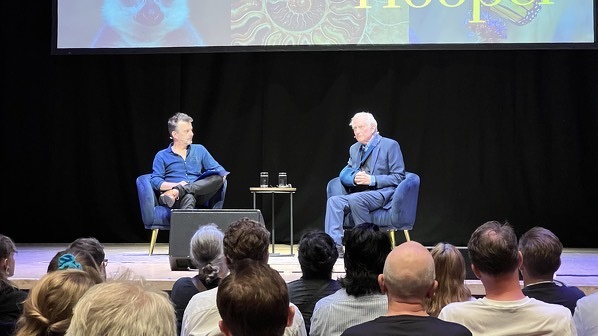
As I said, we went to see Richard Dawkins at the Barbican last night. He was being interviewed by Rowan Hooper, a geneticist, New Scientist writer, and the author of Togetherness.
The reason for the event was the celebration of fifty years since The Selfish Gene was published. The talk, as you might expect, was all about genetics, and the book and its effects over the time. Dawkins is amazingly sharp at 85. He impressed me with just how many names he remembered — of people, books, and species. It was very impressive.
The most interesting part for me was his explanation of what he calls the ‘extended phenotype’ (also the title of one of his books), which explains how the things organisms build or do form part of the carrier of their genes. For example birds' nests. They are not part of a bird’s body — its phenotype — but the better a nest is, the better the bird’s chances of survival and the passing on of its genes. Other examples include parasites that affect the behaviour of species they inhabit.
As I sat there in the Barbican Hall, which is more familiar to classical music performances, I wondered if humanity’s extended phenotype — or rather we’d need a word that matches phenotype at the species level. — includes the construction of better concert halls, of culture more generally. There’s an idea there, I’m sure, but I’d need the brain of a Richard Dawkins to formulate it fully
In the second half there was a Q&A. We had to submit questions using the Slido web app, which removed the ability for ‘This is not so much a question as a comment’ and other long-winded interruptions, but felt a little disconnected. I submitted a question, but didn’t expect it to be used, as it was a big switch from what the event was about, being about Dawkins’s recent thoughts on ‘AI’ (archive.is link), which I wrote about before. Questions were restricted to 160 characters, which seems shockingly short nowadays. I managed to condense mine down to:
You wrote that you believed AIs are alive. If a computer model of the climate is not the climate, is a computer model of some part of a mind a mind?
Which gets at the question, keeps the analogy, but doesn’t quite express all I wanted.
No matter, it was a very enjoyable event, and there’s no way Dawkins has lost his mind.